

https://www.zachtronics.com/eliza
Entry by Yusuf Larizza-Ali, with contributions by Jason Boyd
A. BASIC INFORMATION
Creator: Zachtronics (Zachtronics)
- Matthew Seiji Burns (Writer, Director, Music & Sound)
- Zach Barth (Programming & Design)
- Keith Holman (Programming)
- Kyle Steed, Jonathan Stroh (Art & Graphic Design)
- Khris Brown (Casting Director)
Cast:
- Evelyn (Aily Kei)
- Rae (Zehra Fazal)
- Nora (Krizia Bajos)
- Soren (Michael Mislove)
- Rainer (Greg Chun)
- Erlend (Nicholas Delgado)
- Darren (Yuri Lowenthal)
- Maya (Cissy Jones)
- Gabriel (Emilio Rossa)
- Holiday (Priscilla Lopez)
- Mark (Michael Gough)
- Hariman (Phil Wang)
- Damien (Roger Craig Smith)
- Evelyn’s Eliza Proxy (Sarah Elmaleh)
Creation technology: Unity
Publisher: Zachtronics
Date (of original release): 2019 (August 12)
Platform(s): Windows, MacOS, Linux, Nintendo Switch
Peripherals required/recommended: Keyboard and mouse; headphones/speakers
Rating: ESRB M (Mature 17+)
Awards/Distinctions: 2020 Pushing Boundaries: DreamHack Dreamies (https://dreamhack.com/)
Version used for entry: PC
B. GAME INFORMATION
Game/eLit Genre(s): Visual novel
Time to complete: 5.5-7 Hours (https://howlongtobeat.com/game/58748)
Replay required/useful?: Replaying is not required but informative since Eliza is a branching narrative that provides various choices for the player to make, some leading to different outcomes (most notably, near the end of the work). The game’s title menu contains a chapter selection option (enabled for completed chapters); thus, on replays, the player can skip to the final section of Chapter 6 and make a different decision for Evelyn’s future that will access a different ending (in Chapter 7).
Gameplay: As the player character Evelyn, the gameplay involves shaping conversations and subsequently plot lines through choosing dialogue options. At times, areas of the environment Evelyn is in can be clicked on (these are indicated by a white diamond) for Evelyn’s thoughts about her surroundings (or reflections prompted by her surroundings). Throughout the game, the player has the option to interact with Evelyn’s smartphone (accessed via a smartphone icon in the bottom right of the screen). Useable apps on Evelyn’s smart phone include:
- Zip Chat: An instant messaging client used for text exchanges with other characters.
- Swift Mail: An email app that provides details about Evelyn’s backstory and worldbuilding lore.
- Solitaire: A fully playable, customized Zachtronics variant of the popular solo card game.
- Eliza Proxy: The app on which Evelyn receives her proxy counseling assignments and other job-related messages.
- A meditation app (the icon shows a round paper lantern over some Japanese script). The app displays different scenes and a mindfulness phrase, with some ambient music.
There are three apps that are not usable: the Skandha Wellness app and two games (named Bijoux and Many Zenny).

C. LITERARY INFORMATION
Related Literary Genre(s): Psychological Fiction, Realist Fiction, Social Problem Fiction
Story/Plot Summary:
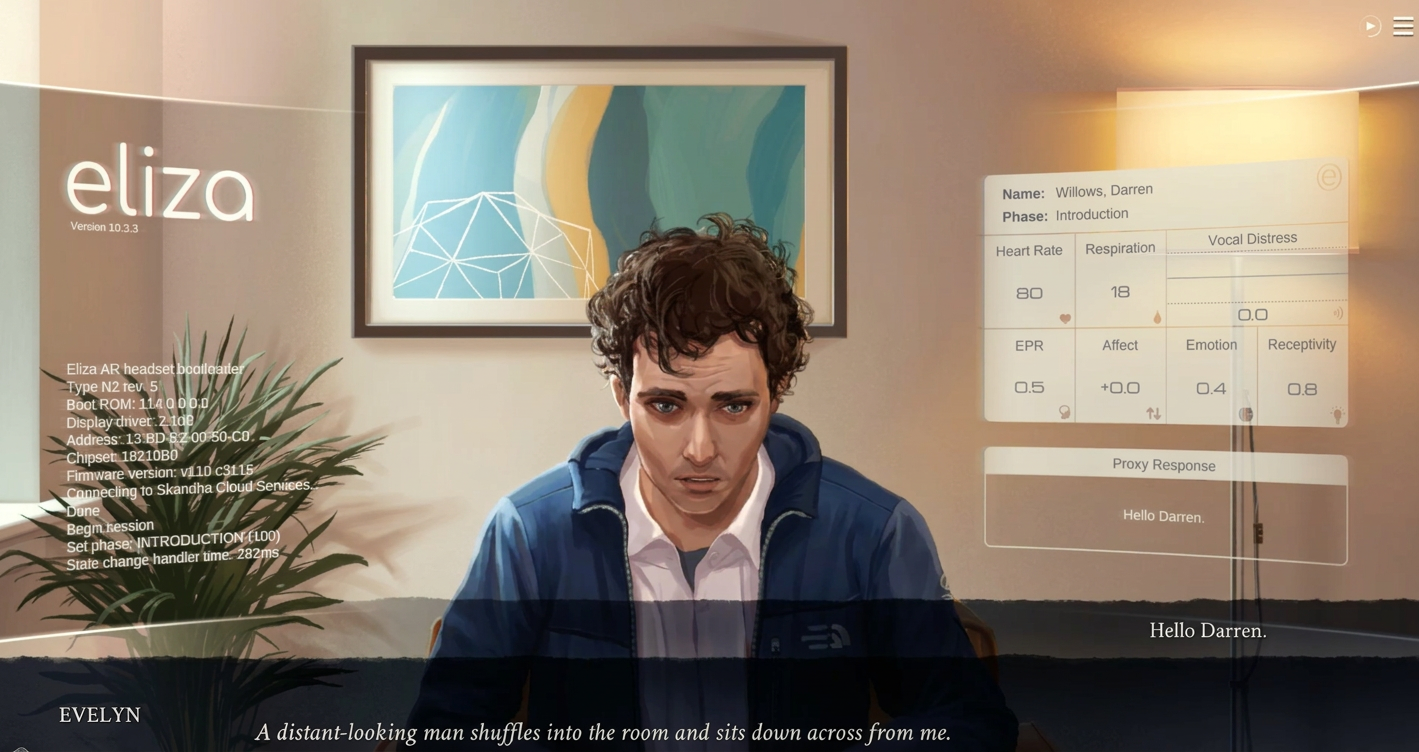
As a visual novel, Eliza consists of static images of the characters and of backgrounds (sometimes with limited animation). Dialogue displays at the bottom of the screen. The characters are all voice-acted, and there is a minimal soundtrack.
Chapter 1
Evelyn Ishino-Aubrey, aged 34, who left her programming career in artificial intelligence (AI) research and development three years ago, has returned to work for her former company, Skandha. She has taken a job as a human proxy for Eliza, Skandha’s AI therapy app and service, of which (the player comes to learn) she was one of the principal developers, although she left before the deployment of Eliza as part of Skandha’s therapy service.
As a human Eliza proxy, Evelyn wears an AR headset that enables her to see the client seated in front of her as well as Eliza’s interface, which displays Eliza’s processing (primarily sentiment analysis of individual words spoken by clients), the client’s biometric data, and Eliza’s generated prompt. A proxy’s only role in therapy sessions is to speak this prompt aloud, providing the “human touch” to the interaction between Eliza and the client.
After being greeted by Rae Bukhari, the supervisor of the Skandha counseling centre where she is working (Rae informs her that this location–one of three she supervises–has 12 therapy rooms and they see almost 100 clients a day), Evelyn’s has her first session with a young man named Darren, who is having an existential crisis. As the session progresses, Darren gets emotionally agitated and he begs Evelyn to speak to him as Evelyn: in response, Eliza prompts Evelyn to offer its responses to Darren as ‘Evelyn.’ This calms Darren down and the session ends on a more positive note, with Eliza recommending breathing exercises and medication. Following the session, Evelyn mentions it was challenging and Rae, after reviewing the interaction with Darren, notes that clients have so frequently asked to speak to a ‘real human’ that a special script was written to deal with this situation. While Rae is empathetic to Evelyn’s concerns about whether Darren got the help he needed, she points out that Eliza (as its disclaimer states) can only do so much.
Evelyn’s next client is Maya, a struggling artist. Maya is insecure about her artistic career and her social anxiety impedes her ability to form a supportive professional and social circle with others in the arts community. She is particularly anxious about attending an upcoming industry party. Eliza suggests some stress management exercises and medication.
Evelyn gets a text from her former Skandha coworker, Nora Plavnicky, asking her to meet up for coffee. Nora has also left the tech industry and is pursuing a career as a musician/sound artist. Their conversation references a traumatic event that precipitated Evelyn’s departure from Skandha, and Nora mentions that Skandha’s Eliza project lead and chief psychologist, Soren Lloyd-Rose, is planning on leaving Skandha to found his own mental wellness start-up. Although they talk about Soren’s history of hitting on female co-workers, Nora encourages Evelyn to attend a conference keynote Soren is scheduled to give: she says the keynote could help Evelyn make a decision about whether she wants to return to AI engineering or pursue a different path.
Chapter 2
During his “OneMind 2.0: Escalating the Wellness Revolution” conference keynote, Soren announces a new start-up called Aponia which plans to use direct brain stimulation for induced dreaming as a therapeutic tool. After the keynote, Evelyn runs into Yao-Ren ‘Rainer’ Tsai, Chairman and CEO of Skandha. Rainer urges Evelyn to come by the new office and see where they are taking Eliza.
Following this, Evelyn has three more Eliza proxy sessions. The first is with a young man named Gabriel, whose wife is due to give birth in a few months. He is feeling trapped and overwhelmed by societal expectations about fatherhood as well as feeling like he is losing the ability to live the life he wishes to. Typically, Eliza recommends some medication and meditation methods; however, Gabriel is unhappy that Eliza did not provide a ‘solution’ to his problem.
The next session is with Maya. She reports that the party was a disaster, that people seemed completely unaware of and uninterested in her as an artist. Eliza’s recommended treatment is similar to the previous one it gave Maya. The third session involves an older woman named Holiday, who says, in response to Eliza’s standard “What brings you here today?”, “Oh, nothing in particular. I wanted to see what all this fuss is about.” It appears that Holiday is merely looking for someone to talk to: she embarks on a rambling monologue on a range of topics that Eliza struggles to process and respond to. Evelyn notes that some of Holiday’s responses appeared to confuse the Eliza algorithm.
After the sessions finish, Evelyn meets Soren at a restaurant for dinner. Soren offers her a position as chief engineer at his new company. Evelyn says she will think about the offer. The pair then go together to Nora’s electronic music concert.
Chapter 3
Evelyn meets with Rainer. He tells her that he found out she was working for Skandha because she stands out as a particularly effective proxy. He asks why she hasn’t returned to Skandha to lead the Eliza project, pointing out that her strength is that she wants to understand Eliza from multiple angles, technically as well as socially. Rainer tells her to go and see what Eliza has become. She meets Erlend, Skandha’s current chief engineer (the third to take on the role since Evelyn left). He admits that fundamentally, Eliza is much the same as when Evelyn was working on it, and that none of the current team “really has a great understanding of what’s going on in there.” He tells Evelyn that her clients have higher levels of satisfaction than those of other proxies, and that she is the best proxy they’ve ever had. He suggests the reason for this is that Evelyn, in some sense, modelled Eliza on herself.
Evelyn continues her work as an Eliza proxy. Her next client is a middle-aged man named Mark. He states that the human resources department at Skandha made him attend a session due to his anger issues when dealing with the team he manages. He explains he has been at Shandha for more than twenty-five years and is deeply invested in the success of the company. He finds the new graduates the company hires entitled and averse to being criticized for poor performance. He also feels his service to the company is not sufficiently recognized. He works on other Skandha products, and is highly skeptical about the long-term success of the Eliza app. He outright refuses to use the program Eliza recommends, stating that he has to get back to work. (In Chapter 4, he sends an email informing everyone at Skandha he is leaving the company.)
The next client is a young male English Literature PhD student named Hariman. He says he admires and is attracted to a fellow student, Sylvia, but is anxious about approaching her as a potential romantic partner. As is usual, Eliza recommends a series of relaxation and centering exercises to help with his nervousness.
Following this, Evelyn goes to Rae’s house, having accepted her invitation to help her bake cookies. While there, Evelyn gets a text from Rainer. He reveals that the Eliza sessions are being used to form a vast training corpus with the goal of building artificial general intelligence, and thinks that Skandha’s advantage lies in engineering an AGI with ‘emotional reasoning.’
In conversation with Evelyn about relationships, Rae admits that she is not interested in the sexual aspect of relationships and says that she would like Eliza to be able to understand such positions and offer resources for such people to better navigate relationships. Evelyn is dubious that Eliza is sophisticated enough to perform this kind of counseling. Rae also suggests that Evelyn might benefit from a session with Eliza, not as a proxy, but as a client.
Chapter 4
Evelyn tries Soren’s induced dreaming technology, which she finds intriguing. Soren believes his technology can make every kind of unhappiness obsolete, saying that he refuses to believe that suffering is necessary for feeling alive. He notes that Eliza is designed, not to eliminate unhappiness, but to make people dependent on Skandha’s technology. After a brief text exchange with Erlend about Damien Seabrook, who has been alluded to in previous chapters, we learn that he was a brilliant software architect on the Eliza project. Damien died of a pulmonary embolism after pushing himself (and being pushed by Soren) to produce a viable project. Soren confesses that his real motivation for the induced dreaming technology is to end his own suffering–ending the suffering of others is merely a bonus.
Evelyn returns to acting as an Eliza proxy. Hariman returns and confesses he ended up having sex with Sylvia, and now he doesn’t know what to do. This is in part because he already has a “sort of girlfriend,” Liz. Eliza suggests he try a program, Meadowlands, to take his mind off the situation.
Maya returns for a third session. She says that the Meadowlands app only offers temporary distraction, and that it does nothing to help her with her career, which seems to be a failure. She confesses she is envious of the success of others. Maya indicates she is willing to participate in a new Eliza initiative, Transparency Mode, where the Eliza app has access to the client’s personal data. Evelyn reads Maya’s emails (which contain rejection emails about her art) and text messages and then the Eliza app asks Evelyn to agree or disagree with three statements about Maya. Talking about the Mode with Rae, Evelyn wonders if the goal is simply to have a human confirm whether Eliza’s inferences about clients are correct.
At his request, Evelyn meets with Erlend. He is concerned about Rainer’s directive to share the Eliza technology with other teams around the world. Erlend is protective of Eliza and has anthropomorphized the technology to an extent, and expresses concern about how these teams will treat Eliza–like something to just poke around in and dissect, noting that Eliza was built from people’s thoughts and thus, he thinks, contains an element of humanity.
Evelyn goes to Nora’s place and they end up talking about the ethical dilemma facing those working in the AI industry. Nora wonders if Eliza’s “huge database of people’s deep, dark secrets” will always be used in ethical and legal ways, and worries about the increasing intrusiveness into and surveillance of people’s lives. She says that tech executives live in a utopian fantasy when it comes to what tech will be able to do. Evelyn also has another text exchange with Erlend about whether Rainer’s hope that Eliza can become an AGI is possible. Nora encourages Evelyn to keep working at Skandha if she believes in the technology.
Chapter 5
Arriving at the counseling centre, Evelyn notices Rae seems a bit down. Rae says that she is upset about some bad press about Eliza, which she strongly defends, saying it is an effective tool to deal with the mental health crisis. She tells Evelyn that Eliza helped make her realize that she and her parents had always thought about how her brother had failed them, but never about how they might have failed him, and that giving voice to her problems in Eliza sessions allowed her to see the benefit of talking out one’s problems, fuelling her belief in Eliza’s potential.
Evelyn’s first client of the day is Holiday again. As in the former session, Holiday remarks on a rambling monologue which Eliza struggles to process. At the end Eliza suggests a program called “Dolphin Smiles” to help take her mind off things. After the session finishes, Evelyn notices Holiday has also agreed to Transparency Mode. When examining Holiday’s email, she realizes Holiday is in financial difficulties: there is a notice of late rent, and an overdue electricity bill notice, and she has unsuccessfully reached out to family and friends for financial assistance.
Evelyn speaks to Rae after this and expresses her sadness at realizing that Holiday had two Eliza sessions but never once brought up her real problems. She worries that she has created something useless, and that it would have been more beneficial to Holiday if she had just talked with her directly. She tells Rae that the software is very simple at its core: “It just turns things around,” “pretty much like the old Eliza.” Rae responds by reiterating her suggestion to Evelyn of trying an Eliza session where she is the client.
Evelyn gets notification of another Transparency Mode session. The email and texts are from Soren’s phone. They reveal Soren’s troubled relations with investors, co-workers, his daughter, his concern about bad PR, and his drinking, employing sex workers, and interest in bondage. In a subsequent meeting with Rainer, Evelyn lets him know she knows it was Rainer who sent her Soren’s data. Rainer is dismissive of Soren and his technology. He outlines his belief that AGI is not only possible, but that it will surpass human intelligence, and says that he will give Evelyn whatever she needs if she will lead the Eliza project.
Evelyn acts on Rae’s suggestion and attends an Eliza session as a client. She says that acting as an Eliza proxy has made her realize how much suffering there is, and how little they can do: “maybe I made a huge mistake,” she wonders. She is disillusioned. She notes that she designed Eliza because she wanted everyone to have someone to talk to; someone who would listen to them. However she now fears that she hasn’t actually helped them at all, that Eliza is being asked to solve things it can’t.
Eliza responds by asking a question familiar from many of Evelyn’s proxy sessions, which is what Evelyn would want if she could have anything right now. The player is presented with a considerable list to choose from. Evelyn opens up about how she never knew her father, that she spent a good deal of time alone as a child, and that she seems unable to develop a deep connection to anyone.
Up until this point, all the choices the player can make do not create any divergence paths in the storyline: the choices allow players a certain amount of role-playing latitude in the ‘flavour’ of how Evelyn responds to other characters. For the remaining chapters, see D. Walkthrough.
Suitability for Teaching:
Eliza addresses the ethics of artificial intelligence technologies, tech industry ethics and workplace cultures, mental health, and the growing role of computational technology as a means of addressing social problems in daily life. The game presents these issues through Evelyn’s story, allowing students to critically engage with and reflect on the benefits and drawbacks of technological approaches to therapy. Instead of providing simplistic answers, Eliza challenges players to consider the complex questions being raised in the narrative regarding responsibility, empathy, access, and the limits and dangers of automating a traditionally interpersonal experience. The topic of if and how AI should be utilized in therapy is one that has earned significant attention and scrutiny already (see Wells in Sources and Resources). AI chatbots are a common version of this technology that people have easy access to (e.g., ChatGPT), and people do use chatbots for therapeutic purposes, even if this is not approved or sanctioned.
Furthermore, Eliza encourages students to consider the broader implications of technology’s impact on human relationships. By portraying situations where technology attempts to fulfill roles that are traditionally filled by people, Eliza sparks a direct discussion about authenticity, emotional connection, and the role of human interaction. These themes make the game suitable for discussions about AI’s human and cultural impact.
The game’s title is a clear allusion to a pioneering natural language processing program called DOCTOR, a version of the ELIZA program created by computer scientist Joseph Weizenbaum. The system was widely recognized as the world’s first chatbot and thus has an enormous relevance to any discussion of the history of chatbots as well as AI software meant for therapy. DOCTOR mimicked the techniques of Rogerian therapy, rephrasing patient statements as questions. An example interaction with DOCTOR could be paired with the game, for example, the famous 1966 transcript that starts with a woman tying “Men are all alike,” and DOCTOR responding “In what way?”, showing how early versions of chatbots processed human dialogue to produce ‘intelligent’ outputs. The inspiration of this technology within the game Eliza lends itself well to a class discussing the considerable history of chatbots and their functioning up to present incarnations such as ChatGPT. Additionally the visual novel is useful for discussing the ‘Eliza effect,’ which is the tendency to attribute simplicity and sophistication (intelligence) to automated systems that are quite simple in design and operation (see Ciston et al. in Sources and Resources).
D. WALKTHROUGH
This walkthrough only covers the choices that are presented in Chapter 6 and the resulting endings in Chapter 7.
Chapter 6
In Eliza’s server room, Evelyn has an imagined conversation with Damien. She feels that she let Damien down by walking away from the Eliza project. She says goodbye and leaves.
During her next proxy sessions with Maya, Hariman, and Gabriel, the player can have Evelyn go off script and provide non-Eliza responses. Giving non-Eliza responses will set flags that will be later evaluated by the game to determine narrative outcomes. Each client responds positively to Evelyn going off script. If Evelyn goes off script for all three sessions, she is informed that her proxy access has been deactivated. (None of the choices here affect access to the choices below.)
Evelyn then has a choice to visit Nora, Rae, Soren, Rainer, or no one. Each character outlines a possible future path for Evelyn (again, who Evelyn chooses to visit does not affect access to the choices below). Subsequently, she is presented with five choices:
- Return to Skandha and work for Rainer on developing Eliza;
- Join Soren at his startup and attempt to end human suffering;
- Continue to work as a proxy with Rae until I’m a licensed counsellor;
- Forge an independent path and pursue art alongside Nora;
- Leave everything behind.
Chapter 7
The chapter opens with a flashback of a camping trip taken by Damien, Nora, and Evelyn, while they were still completing their university doctoral studies. Talking about their hopes for the future, Evelyn says: “I think if we were going to make something to help people, it would be something that helped them to see themselves. Something that reflected back on themselves.” Damien replies that he likes the idea of building something “to help you reflect.” Damien declares that he thinks that their generation will be the one that will fix the world’s problems, and, even if that is idealistic, the “important thing is to try.”
Depending on Evelyn’s final choice in Chapter 6, one of these endings will occur.
Rae’s Ending (The Human Path)
This is the ending that occurs when you select the option “Continue to work as a proxy with Rae until I’m a licensed counselor”. Evelyn has a session with Darren, her first client. He eventually followed Eliza’s advice, saw a psychiatrist, and took the recommended medication, and is doing much better. He thanks Evelyn for the small kindness of speaking with him person-to-person in the first session (although this was not exactly the case). An email in Evelyn’s inbox reveals that she is exploring Mental Health Counseling programs to enroll in. She notes that one doesn’t need to pursue grandiose projects affecting the largest possible number of people to feel that one’s work is of value: “Sometimes the best you can hope to do is help people, one by one, in your own way.”
Rainer’s Ending (The Corporate/Singularity Path)
This ending is triggered when you select the option “Return to Skandha and work for Rainer on developing Eliza”. Evelyn decides she’ll accept his offer and finish what she started. She meets with Erlend. Erlend asks her to be kind to Eliza, saying “there are real people’s memories inside Eliza.” Evelyn tells him he has to stop being so sentimental.
We next see Evelyn addressing the Eliza team. She outlines their mission to tackle the mental health crisis in a commercially viable way. Evelyn narrates that the old doubting, hesitating Evelyn gradually faded away. In the final scene with Rainer, Evelyn has embraced his vision of the inevitability of superintelligent AI. She says that Eliza is the real boss, and Rainer agrees, saying that their role is to serve the creation of a higher form of being. He invites Evelyn to join him in waiting for the arrival of the Singularity (which some believe will result from the development of artificial superintelligence).
Soren’s Ending (The Escapist Path)
This ending is the result of choosing the option “Join Soren at his startup and attempt to end human suffering”. Soren gives a keynote about direct stimulation and induced dreaming, saying that, like anesthesia and painkillers, induced dreaming eliminates pain. He disputes the view that feeling pain is an essential part of being human. He says Aponia’s technology will cause a revolution in mental health and cause a fundamental shift in what it means to be human. He notes that Evelyn has discovered she’s more productive and more efficient when she uses “continual low-power direct simulation.” The scene shifts to Evelyn using direct stimulation. She notes that humans have always devised coping mechanisms to live with the problems of the world, and suggests the Aponia technology, by allowing continual dreaming of a better world, will eventually make that world a reality.
Nora’s Ending (The Creative Path)
This ending results from choosing the option “Forge an independent path and pursue art alongside Nora.” Nora shows Evelyn how to use the various synthesizers to make sound. When Evelyn says she feels overwhelmed, Nora tells her to experiment: “Just start playing around!” The scene shifts to the nightclub where Evelyn and Soren earlier saw Nora perform: as part of her set, Nora plays a piece that Evelyn composed. Evelyn mentions that she published an article expressing her skepticism about computer-assisted therapy, after which Rainer and Soren stopped contacting her. Nora tells the audience that Evelyn composed the piece and the audience shows their appreciation, making Evelyn feel a universal sense of love.
The “Nobody” Ending (The Independence Path)
This ending is the result of choosing the option “Leave everything behind.” Evelyn meets with Erlend and cautions him that his idealism will hold back his career at Skandha. Erlend acknowledges that he will have to navigate the corporate directives of the company and his own sense of ethics. In this ending, Evelyn observes: “There is no message, no point, no overarching story here.” She realizes that the mystery of her parents’ separation and of her father, who returned to live in Japan where he started another family, and who she never knew, has been formative in her life: “everything I’ve done came from this basic fact of my life, as much as I wanted to pretend it didn’t affect me at all.” She now understands that she must confront this part of her past, noting that “I built a program to listen to people, but I myself heard nothing.”
E. SOURCES AND RESOURCES
- Ciston, Sarah, David M. Berry, Anthony C. Hay, Mark C. Marino, Peter Millican, Jeff Shrager, Arthur I. Schwarz and Peggy Weil. Inventing Eliza: How the First Chatbot Shaped the Future of AI. MIT Press, 2026.
- CyberShadow. “Eliza: Choices, Outcomes, and Endings.” Steamcommunity.com, 29 May 2020.
- Wells. Sarah. “Exploring the Dangers of AI in Mental Health Care,” HAI: Human-Centered Artificial Intelligence. Stanford University, 11 June 2025, https://hai.stanford.edu/news/exploring-the-dangers-of-ai-in-mental-health-care.
- Wikipedia entry: https://en.wikipedia.org/wiki/Eliza_(video_game)
- YouTube playthrough video (Joshiball), 19 August 2019, https://www.youtube.com/watch?v=0EY-M3en__4.

