Critical Play: Radical Game Design

Flanagan, Mary. Critical Play: Radical Game Design. Cambridge, Massachusetts: The MIT Press, 2009. Print. (Access Flanagan’s introduction online here.)

9780262062688Mary Flanagan’s Critical Play is a call to develop a new methodology that will allow activist games to be created in greater numbers, and for games in general to be designed with increased diversity. “Critical play” refers to games and other types of play that involve the examination of social, cultural, political, and personal themes and issues, wherein the goal is not to win, but to think and discuss the issues within the safe space created by play. In these types of play, critical thinking, education, intervention, and humanistic themes are emphasized. Continue reading “Critical Play: Radical Game Design”

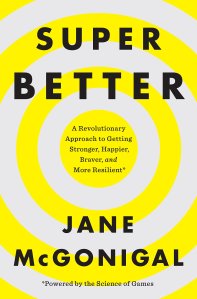
You Can Make the Leap from Games to Gameful, in Super Better

superbetter

McGonigal, Jane. “You Can Make the Leap from Games to Gameful.” Super Better: A Revolutionary Approach to Getting Stronger, Happier, Braver and More Resilient⎯Powered by the Science of Games. Toronto: Penguin, 2015. 104-29. Print.

The transition from just playing games to playing games mindfully is an essential aspect of accessing the benefits of gamefulness. McGonigal argues that a gamer should play with purpose, rather than with the escapist attitude that is most often adopted by gamers. Escapism encourages players to escape their daily life and its problems, thus convincing them to believe that their problem solving skills are insufficient for dealing with life’s difficulties. To play with purpose, instead, is to identify a game’s benefits (i.e. team building) and find this benefit’s purpose in a real-life situation (i.e. working collaboratively on a shared project at work). The method to accessing the benefits of game playing, or being gameful, is the application of these virtually accessed skills in a real-life setting. McGonigal discusses the health paradox for gamers: self-suppressive gamers, those who avoid their issues by gaming, are often physically and mentally unwell, suffering from depression, social isolation, anxiety, and a host of other issues; self-expansive gamers, those who apply virtually learned skills in real life settings, excel in terms of their happiness, health, and test scores. Studies show that both are possible consequences of game playing, and both are valid. The difference is purpose in playing, or the why. To rely on games to distract from problems, rather than to inform a problem and present a solution, is defeatist. A “purposeful play,” instead, works against this instinct to distract. Gamers seek out benefits, such as education, exploration, creativity, relaxation, and can consequently “activate [their] gameful skills in real-world contexts” (106). Continue reading “You Can Make the Leap from Games to Gameful, in Super Better”

Interface and Interpretation, in Graphesis

Drucker, Johanna. “Interface and Interpretation.” Graphesis: Visual Forms of Knowledge Production. Cambridge, MA: Harvard UP, 2014. 138–179. Print. By Nathalie Down The chapter “Interface and Interpretation” from Johanna Drucker’s latest book, Graphesis, provides an exceptional and much-needed critique of the graphical user interface (GUI), the dominant feature of screens on most modern computational devices. Although the value of the chapter tends be overshadowed by the book’s more prominent knowledge contribution – the groundwork for an essentially new field of graphic-based semiotics – the insights presented within are of critical import to scholars across disciplines, to designers and engineers, and indeed … Continue reading Interface and Interpretation, in Graphesis

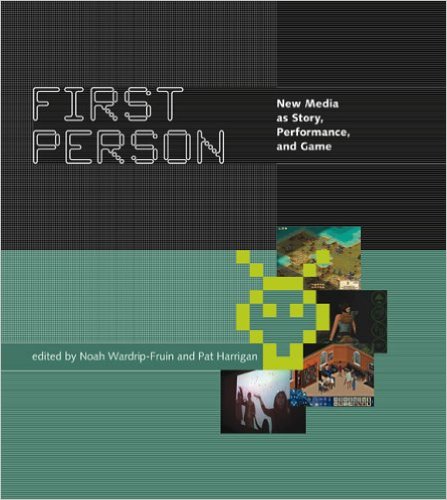
First Person: New Media as Story, Performance, and Game

Image of book cover

Harrigan, Pat and Noah Wardrip-Fruin. First Person: New Media as Story, Performance, and Game. Cambridge, MA: MIT, 2004. Print.

The contributing authors to this collection of essays question the relationship between stories and games and explore new types of textual experiences made possible in the digital environment. The connection between stories and games especially relates to the digital storytelling and gameful experiences theme of the Stories in Play Initiative. The authors examine blurry terms such as play, games, narrative and interactivity in their work. Reflecting the interactive digital environment in examination, the book is structured as a series of panel discussions, where each essay is followed by responses. The contributors represent a range of backgrounds including theorists, game designers and artists. Furthering the notion of interactivity, readers and the public are invoked in the book’s concerns, as the editors of First Person also created a website in collaboration with electronic book review with the opportunity for further online discussion. Continue reading “First Person: New Media as Story, Performance, and Game”

The Ecology of Games

The Ecology of Games:  Connecting Youth, Games, and Learning. Ed. Katie Salen.  London:  MIT P, 2008.  Print.

By:  April Tanner

The Ecology of Games:  Connecting Youth, Games, and Learning is a collaborative work edited by Katie Salen that seeks to demonstrate the sociocultural value of games in the digital age. Salen considers gaming to be a comprehensive term which encompasses gaming practices, literacies, and activities across all platforms and spaces. The central goal of the collection is to answer questions regarding how youth engage and participate in games and gaming, how gaming literacies form, how gaming interacts with other forms of learning and social interactions, and how barriers that prevent participation in gaming can be identified and overcome. Continue reading “The Ecology of Games”

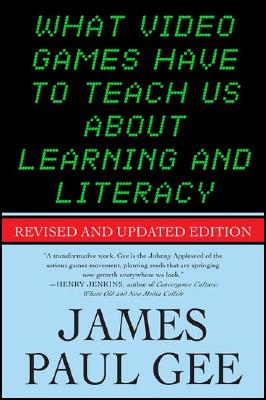
What Video Games Have to Teach Us about Learning and Literacy

What-Video-Games-Have-to-Teach-Us-about-Learning-and-Literacy-9781403984531

Gee, James Paul. What Video Games Have to Teach Us about Learning and Literacy. Gordonsville, VA, USA: Palgrave Macmillan, 2003. ProQuest ebrary. Web.

In his book What Video Games Have to Teach Us about Learning and Literacy, author James Paul Gee explains what video games have to offer users in terms of developing literacy skills, pedagogical applications, and learning principles that provide the framework for well-made video games. In the introduction, Gee begins with a central question: “what determines how you read or think about some particular thing?” (2). Throughout the introduction to his text, he pulls apart that question to identify how video games are a fruitful part of the discussion surrounding developing understandings of learning, literacy, and how to effectively teach these skills. Within each chapter of this book, Gee elaborates on a significant aspect of the relationship that video games can have to learning and acquiring literacy skills. This annotation will focus primarily on the first four chapters.   Continue reading “What Video Games Have to Teach Us about Learning and Literacy”

Postfeminist Digital Cultures: Femininity, Social Media, and Self-Representation

Dobson, Amy Shields. Postfeminist Digital Cultures: Femininity, Social Media, and Self-Representation. New York: Palgrave Macmillan, 2015. Print.

Dobson’s critical study grapples with the question of what it means to perform femininity in contemporary digital cultures. Her book attends to both digital spheres and genres of digital media, using platforms such as social networking sites, as they span and straddle our understandings of the public and private, personal and professional. Her subjects of study are young women and the ways in which they interact with media as an expression of identity through digital self-representations. These online identities and self-representations, she argues, carry with them the political implications of negotiating conditions within post-feminist techno-social mediascapes. Dobson uses cultural theories such as the Foucauldian notion of regulation, to investigate the cultural ramifications of self-representation within a participatory and interactive culture, emphasizing the systems of power, coercion, and exploitation at play within these mediascapes. How, for example, does one negotiate their identity and agency in order to participate and belong within this growing online culture? What are the implications of submitting to these forms of control in one’s authentic representation of self? Continue reading “Postfeminist Digital Cultures: Femininity, Social Media, and Self-Representation”

Literary Gaming

lit gaming

Ensslin, Astrid. Literary Gaming. Cambridge, MA: The MIT Press, 2014. ProQuest ebrary. Web. 7 February 2016.

Astrid Ensslin’s book Literary Gaming examines the intersection between ludic and literary experiences. She proposes that her text will highlight the ways in which reading and gaming can be combined and presents these processes to both users and analysts. This suggests her work will be of use to practitioners in the field as well as researchers who wish to learn more about the gamefication of literature and literary studies. Ensslin argues that the fusion of linguistic arts and videogame technologies is both necessary and mutually beneficial (for both computer gaming and electronic/digital literature). Continue reading “Literary Gaming”