
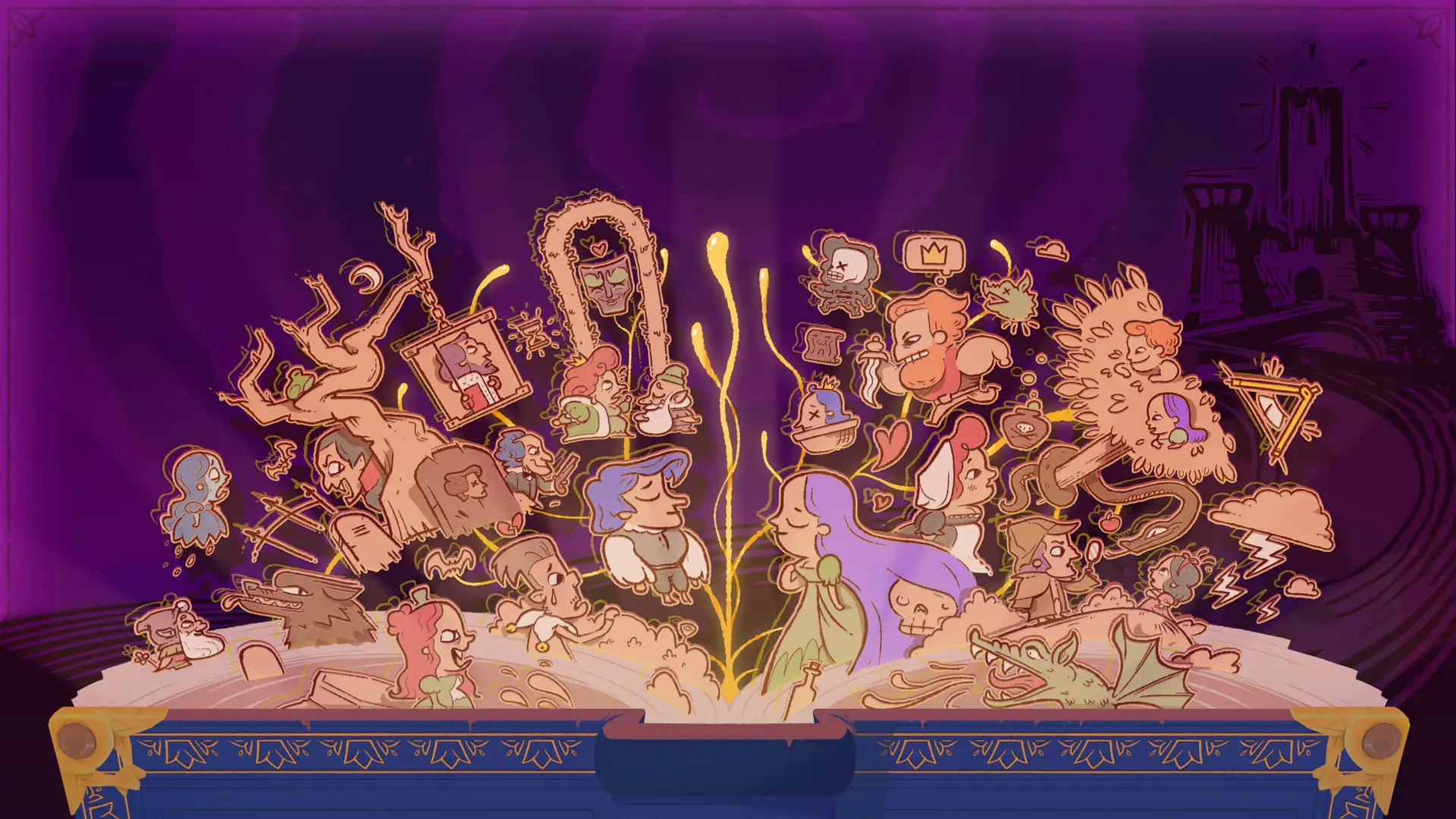
https://annapurnainteractive.com/en/games/storyteller
Entry by Leila Kazeminejad
A. BASIC INFORMATION
Creator(s):
- Daniel Benmergui (Developer): http://ludomancy.com
- Jeremias Babini (Artist)
- Zypce (Composer)
Creation technology: Unity
Publisher: Annapurna Interactive: https://annapurnainteractive.com/en
Date of Original Release: March 23, 2023
Platforms: PC, MacOS, Nintendo Switch, iOS, Android, Netflix
Peripherals Required: Keyboard/mouse or Touchscreen-enabled device; speakers/headphones
ESRB Rating: T (Teen)
Awards & Distinctions:
- Independent Games Festival 2012: Nuovo/Innovation Award
- Thinky Awards 2024: Most Approachable Game
Version used for entry: 1.1.18 (October 16, 2023) for PC
B. GAME INFORMATION
Game/eLit Genre(s): Narrative Puzzle
Time to complete: Approximately 2 hours. Time to completion largely depends on how quickly the player is able to solve the puzzles. For 100% completion, around 3 hours of game-time is recommended.
Replay required/useful?: A single playthrough is sufficient, although players can replay if they wish to explore other ways of solving some of the puzzles.
Gameplay: The player places (drags and drops) characters and scenes into a series of comic or picture book panels (ranging in number from 3 to 8 panels per story). In each story , the player must place these characters and scenes in such as way that the panels form a causal sequence that represents a story that matches the provided title.
C. LITERARY INFORMATION
Related Literary Genre(s): Folklore and Fairy Tales, as well as plots and common narrative tropes found in classic literature. Beside archetypal characters and plots, there are also stories based on the Book of Genesis, “Snow White and the Seven Dwarves,” and Dracula.
Story/Plot Summary: Storyteller has 14 Chapters, each of which consists of 4 or 5 parts. The Chapters contain a series of loosely-related plots with a recurring set of characters. The game’s plots use common scenarios and archetypal characters from the Bible, fairy tales, folklore, and other classic literature.
Suitability for Teaching:
Given the building blocks of its stories, Storyteller would be a suitable interactive addition to courses focused on myths, folk and fairy tales, and possibly on children’s literature (particularly picture books). As it deals with archetypal plots and characters, it can helpfully illustrate structuralist approaches to folk and fairy tales, as represented by Claude Levi-Strauss’s structuralist, paradigmatic theory of mythology (aiming to uncover the underlying pattern shared by individual stories) and Vladmir Propp’s functionalist ‘syntagmatic’ theory of the folktale (Morphology of the Folktale, first published in Russian in 1928), where a story progress through a series of defined ‘functions’ (for example, Struggle, Victory, Rescue, Punishment, Wedding). Storyteller’s ‘scenes’ appear similar to Propp’s ‘functions’ in that scenes have set effects that often have to be placed in a particular sequence to lead characters to common story resolutions. According to Propp, in folktales “the number of functions is extremely small, whereas the number of personages is extremely large. This explains the two-fold quality of a tale: its amazing multiformity, picturesqueness, and color, and on the other hand, its no less striking uniformity, its repetition” (59).
In relation to theories of narratology, Storyteller could be used in connection to a discussion of narrative causality, or cause and effect, in story plots. For example, in “Seeing the Ghost of a Lover,” if the player does not first establish the love between Adam and Eve through the “love” scene, the death of either Adam or Eve would not fulfill the story as being about the death of a lover. The nature of the gameplay puts emphasis on the each panel as a narrative unit or event as well as how panels connect together using causality to create a plot.
Storyteller relies almost exclusively upon visual storytelling, understanding characters from emotive visual cues they display when placed in particular scenes with particular characters and the stories that result from these combinations. This makes it useful for a discussion of visual literacy and how pictures (or sequences of pictures) can tell a story without text.
D. WALKTHROUGH
Story panels combine characters and scenes, situations which affect the behaviour of the characters. For each panel, the player must place characters (one or two, maximum, with one exception) with scenes in a sequence that tells the story indicated by the title. Each chapter includes a table of contents outlining the title of the chapter, the chapter number, the chapter parts, and any extra criterions or variations. Note that with extra criterions or variations, the number of original panels will stay the same.
Starting with Chapter 2, some stories have an additional criterion that can be fulfilled and are indicated with a yellow bullet point in the table of contents. These are indicated in the Chapter list below with an arrow (→). Not all these additional criteria need to be fulfilled to unlock “The Ceremony,” an achievement for completing all 14 chapters. In “The Ceremony” the player drags an image of a crown from the page on the right to the image of a pedestal on the left. This unlocks the “Epilogue.”
All chapters and parts can be played in any order with the exception of the “Devilish” variants, which are unlocked after “The Ceremony.” The new variants involve a new character, ‘Devil,’ and are indicated by a red star placed next to certain chapter parts in each table of contents. In the Chapter List below, these are indicated with an arrow (→) and the label “(Devil).’’
The Gamer provides step-by-step solutions with images, although it is important to note that some puzzles can be solved in slightly different ways than shown in these solutions, sometimes without needing to use all the panels or with different love interests, including same-sex pairings.
Chapter 1: Life and Death
Characters: Adam, Eve
Scenes: Death, Love, Revive
Chapter Parts:
- Love: Adam Starts Alone, Finds Love, and Dies Happy (3 panels)
- Heartbreak: Eve Dies Heartbroken (3 panels) → (Devil) Devil makes everyone miserable
- Afterlife: Seeing the Ghost of a Lover (3 panels)
- Miracle: Heartbreak with a Happy Ending (4 panels)
Chapter 2: Broken Hearts
Characters: Bernard, Edgar, Isobel, Lenora
Scenes: Amnesia, Death, Wedding
Chapter Parts:
- Recovery: A Heartbreak is Healed → … without any deaths (3 panels)
- Dismay: Rejected by Own Spouse (4 panels)
- Unlucky: Everyone Rejects Edgar (6 panels)
- Grief: Surviving Spouses Find Comfort → (Devil) spouses reject each other (6 panels)
Chapter 3: Apparitions
Characters: Dog, Edgar, Isobel, Lenora
Scenes: Amnesia, Death, Love, Mirror, Revive, Time, Wedding
Chapter Parts:
- Revelation: Edgar Shocks Himself (3 panels)
- Reunion: Heartbroken Spouses are Reunited → …in the afterlife (6 panels)
- Calamity: Heartbreak for Everyone → (Devil) everyone dies sad (6 panels)
- Aging: Old Heartbroken Dog Dies Happy (6 panels)
Chapter 4: The Cellar
Characters: Bernard, Edgar, Isobel, Lenora
Scenes: Death, Fight, Poison, Revive, Wedding, Wine
Chapter Parts:
- Poison: Lenora Drinks Poison (3 panels)
- Tragedy: Double Poison → (Devil) haunted for murder (6 panels)
- Haunt: Isobel is Haunted by her Husband (6 panels)
- Envy: Murder of Jealousy → but everyone meets their demise (6 panels)
Chapter 5: Beauty
Characters: Prince, Snowy, Tiny, Witch
Scenes: Cauldron, Forest, Kiss, Mirror
Chapter Parts:
- Competition: Witch Becomes the Mirror’s Favourite (6 panels)
- Scorn: Curse is Lifted (4 panels)
- Duplicity: A Kiss and a Curse → (Devil) heartbroken frog (6 panels)
- Deceit: Tiny Gets a Kiss → ungrateful maiden OR Prince saves Tiny (6)
Chapter 6: The Manor
Characters: Butler, Detective, Duchess, Duke
Scenes: Ballroom, Gun, Remorse
Chapter Parts:
- Murder: Butler’s Rampage (3 panels)
- Weapon: Duke Feels Relief (4 panels)
- Telltale: Murderer is Arrested (4 panels)
- Fingerprints: Someone Gets Arrested → (Devil) Butler gets shot (6 panels)
Chapter 7: Crown Intrigue
Characters: Dog, Baron, Knight, Queen
Scenes: Cliff, Disguise, Kidnap, Revive, Throne, Wedding
Chapter Parts:
- Rivals: Four Deaths (6 panels)
- Rescue: The Queen is Rescued → …and married OR revenge (3 panels)
- Usurpers: Everyone Sits on the Throne (6 panels)
- Forgiven: Usurper is Forgiven (6 panels)
- Suitor: The Queen Marries (6 panels)
Chapter 8: Secrets
Characters: Butler, Detective, Duchess, Duke
Scenes: Ballroom, Gun, Witness
Chapter Parts:
- Red-Handed: Murderer Gets Arrested (4 panels)
- Thief: Butler Gets Fired (6 panels)
- Revenge: Spouse Gets Vengeance → (Devil) Duke shoots his wife (6 panels)
- Report: Duchess Gets Murderer Arrested → but the Duke isn’t home (6 panels)
Chapter 9: Justice
Characters: Baron, Knight, Queen
Scenes: Amnesia, Cliff, Execute, Death, Kidnap, Revive, Throne, Wedding
Chapter Parts:
- Treason: Usurper Dies → by the hand of the Knight (6 panels)
- Unforgiven: Knight Loses His Head (6 panels)
- Stockholm: The Execution → of the Queen OR of the Baron (6 panels)
- Matriarch: Queen Beheads All Men (6 panels)
Chapter 10: Genesis
Characters: Adam, Eve, Friedrich
Scenes: Gun, Judgement, Love, Revive, Tempt
Chapter Parts:
- Temptation: Eve Rejects Apple (3 panels)
- Punishment: God is Happy at Everyone → (Devil) Adam dies twice (6 panels)
- Repentance: Adam Watches His Love Die → …because of him (6 panels)
- Vengeance: Friedrich Takes Revenge (6 panels)
Chapter 11: The King
Characters: Baron, King, Maid, Queen
Scenes: Affair, Amnesia, Cliff, Execute, Fight, Kidnap, Love, Wedding
Chapter Parts:
- Noxious: Cyclic, Mutually Toxic Love Affair (6 panels)
- Spite: Double Execution → where the King takes revenge (3 panels)
- Purge: Three Heads Roll (6 panels)
- Promotion: Rags to Royalty (6 panels)
- Machiavelli: Baron Rules Alone (6 panels). “Machiavelli” is a reference to Niccolò Machiavelli, who is famous for his political philosophy of acquiring and maintaining power through any means necessary.
Chapter 12: Monsters
Characters: Baron, Bernard, Detective, Dog, Dracula, Isobel, Jon, Juliet, Mina, Queen
Scenes: Affair, Ballroom, Cliff, Crypt, Disguise, Forest, Moon, Night, Poison, Professor, Revive
Chapter Parts:
- Werewolf: Bernard Drinks Poison (6 panels)
- Sematary: Pet Comes Back to Life to Enact Revenge (6 panels)
- Dragon: Queen Gets Baron Arrested (6 panels)
- Vampire: Cured of Vampirism (6 panels)
- Professor: Monster is Slain → Werewolf dies OR Dragon dies (6 panels)
Chapter 13: Drama
Characters: Bluey, Froggy, Greeny, Hatey, Peachy, Tiny
Scenes: Affair, Cliff, Family, Fight Mirror, Seance, Wait, Wedding
Chapter Parts:
- Narcissus: The Mirror Praises Everyone (6 panels). Narcissus is a character from Greek mythology who fell in love with his own reflection.
- Oedipus: Hatey Murders Father and Marries Mother (6 panels). Oedipus is a character from Greek mythology who unknowingly murdered his father and married his mother.
- Hamlet: Tiny Murders His Brother to Avenge His Father (6 panels). Hamlet is the title character of Shakespeare’s famous play.
- Salome: Hatey is Murdered By His Daughter → but he was just protecting her (6 panels). Salome is a character from the New Testament who is prompted by her mother Herodias to ask her stepfather Herod to behead John the Baptist. In Oscar Wilde’s play Salome (originally published in French in 1893), she becomes erotically fixated on John the Baptist (called Iokanaan in the play), who spurns her, prompting her to revenge herself by having him beheaded.
- Godot: Tiny and Hatey Wait Forever → (Devil) they all die (6 panels). Waiting for Godot (1953) is a play by Samuel Beckett about two men waiting for a man (Godot) who never appears.
Final Chapter: Novels
Characters: Detective, Duchess, Duke, Edgar, Isobel, King, Knight, Lenora, Maid, Prince, Queen, Snowy, Witch
Scenes: Affair, Ballroom, Cauldron, Cliff, Death, Execute, Forest, Gun, Poison, Kidnap, Kiss, Mirror, Seance, Throne, Wedding, Wine, Witness
Chapter Parts:
- Mad Husband: Edgar Murders His Wife (8 panels)
- Loose End: Duke shoots Detective to Avoid Prison (8 panels)
- Vindictive Wife: Unfaithful Husband Punished (8 panels)
- Love Revolution: Knight and Maid Murder the Monarchs and Have an Affair (8 panels)
- → (Devil) Last Straw: Knight Imprisons Queen (8 panels)
Characters
(in alphabetical order)
| Adam | The biblical character from the Book of Genesis. |
| Baron | A villain character, the antagonist of the King, Queen and Knight. |
| Bernard | A rough looking man, wearing what appears to be a fool’s or jester’s ruff. Transforms into a werewolf when paired with the Moon scene. Is bisexual. |
| Bluey | A generic dwarf character. |
| Butler | A villain character who uses the Gun to kill the Duke and/or Duchess. |
| Detective | When place in a panel, either Investigates crimes or arrests characters (not always successfully) who have committed murder using the Gun. Modelled on Sherlock Holmes (wears a deerstalker and ulster coat). |
| Devil | A stereotypical devil (coloured red with horns and a goatee). Introduced in the Devilish variations. |
| Dog | A dog character that loves his owners. |
| Dracula | The famous vampire. Can transform other characters into vampires. |
| Duchess | A generic female aristocrat. |
| Duke | A generic male aristocrat. |
| Edgar | A generic romantic hero. Is bisexual. |
| Eve | The biblical character from the Book of Genesis. |
| Friedrich | Based on Friedrich Nietzche, who famously declared “God is dead.” |
| Froggy | A frog. |
| Greeny | A generic dwarf. |
| Hatey | A more masculine dwarf. As his name implies, usually more vindictive than the other dwarves and can be used to stir up trouble |
| Isobel | A female who often takes the role of villain. Is bisexual. |
| Jon | A character based on Jonathan Harker from Bram Stoker’s Dracula. |
| Juliet | A generic female character. |
| King | A generic male monarch. When put in marriage scenes, he acknowledges that he can only marry the Queen despite also loving the Maid. The King can only be swayed to hurt the Queen when he has been slighted by her. |
| Knight | Loyal to the King and Queen. |
| Lenora | A generic romantic heroine. Is bisexual. |
| Maid | Loves the King, but is still obedient to nobility (as long as she is not provoked). |
| Mina | A character based on Mina Murray from Bram Stoker’s Dracula. |
| Peachy | A more effeminate dwarf, regarded as the best looking of the dwarves. Generally good natured, but will retaliate when crossed. |
| Prince | A character based on the Prince in “Snow White and the Seven Dwarves.” |
| Queen | A generic female monarch. Only loves the King and herself by default, but her affection can be earned. |
| Snowy | A character based on Snow White from “Snow White and the Seven Dwarves.” |
| Tiny | A generic dwarf. |
| Witch | A character based on the Evil Stepmother/Witch in “Snow White and the Seven Dwarves.” A beautiful woman with white hair, a deep purple dress, and a black cloak. Can transform into an old woman. |
Scenes
(in alphabetical order)
| Affair | Allows two characters to have a secret love affair whilst another person watches from the bushes. This is the only scene where three characters can be utilized. |
| Amnesia | Makes a character forget previous scenes in which they featured (such as marriage). |
| Ballroom | Allows two characters to meet and express love, contempt, or friendliness. Often paired with the Gun, Witness, and Ballroom scenes to effect a murder or an Arrest. |
| Cauldron | Transforms the Witch into an old woman and allows her to wield her magic wand. |
| Cliff | Allows one character to stand at the cliff’s edge and one character to stand behind them. Depending on the relationship between the characters, the character behind can push the other off the cliff or do nothing. |
| Crypt | Allows vampire characters to rest in coffins, to be encountered by another character. |
| Death | Requires two characters, one character represented on a tombstone and one character kneeling before the tombstone. Reactions to Death depend on the relationship created between the two characters through scenes like Love. |
| Disguise | Allows the Baron to disguise himself as a dragon. |
| Execute | Allows the character that holds the crown to execute those who oppose them. |
| Family | Establishes either a paternal or maternal relationship between two characters. Includes the only case of dialogue (“I am your father”). |
| Fight | Allows two characters to fight, creating animosity between them. |
| Forest | Allows characters to meet and either express love or disgust with each other. Often paired with Cauldron to have the Witch turn an enemy into a frog. |
| Gun | Allows a character to interact with a gun on a pedestal. |
| Judgement | Functions like God, e.g., forbids characters to eat the forbidden fruit. Judgement will smite the character or characters who have eaten an apple from the tree. |
| Kidnap | Allows one character to kidnap the other depending on their relationship. If a character has been kidnapped, another character can subsequently be paired with the kidnapped character to release them depending on their relationship. |
| Kiss | Allows characters (on a boat) to kiss, usually to break a curse. |
| Love | Allows two characters to fall in love. |
| Mirror | Allows a character to look into a mirror even if they are deceased. The Mirror can also be used to learn who the ‘fairest’ character is. |
| Moon | Allows Bernard to transform into a werewolf and back into a human. |
| Night | Allows two characters to stand in the moonlight. When Dracula is utilized, he will transform the other character into a vampire if they are not already a vampire. |
| Poison | Allows a character to poison themself or to poison another character depending on motivations of the characters. |
| Professor | Allows a character to learn how to slay a monster. |
| Remorse | Allows a character to feel remorse over their actions. |
| Revive | Brings a character who has died back to life. |
| Seance | Allows a living character to talk to a dead character. |
| Tempt | Allows a character to converse with a snake that tempts them to eat a forbidden fruit. |
| Throne | Allows the player to establish who holds the crown. Because it defaults to the King or Queen, the crown must be removed from them through Kidnapping or Death in order to crown another character. |
| Time | Indicates the passing of time. |
| Wait | Allows two characters to wait next to a tree. |
| Wedding | Allows two characters to wed. When previously wedded characters are placed with another character in a Wedding scene, they will by default reject the other character. |
| Wine | Allows a character to drink wine. Often this is paired with Poison to indicate that there is poison in the wine. |
| Witness | Allows a character to spy on an interaction in the Ballroom scene from behind a portrait. |
E. SOURCES AND RESOURCES
- Wikipedia Entry: https://en.wikipedia.org/wiki/Storyteller_(video_game)
- Metacritic Critic Reviews: https://www.metacritic.com/game/storyteller/critic-reviews/
- Garcia, Garrett. “Storyteller; How to Solve Every Puzzle.” The Gamer, March 9, 2024.
- No Commentary Gameplay: LJB Games, 2014. https://www.youtube.com/watch?v=qpTvkH6J4U8&t=4417s&ab_channel=LJBGames
- Fandom Wiki: https://storytellergame.fandom.com/wiki/Storyteller_Wiki
- Propp, Vladimir. “Morphology of the Folktale (1928).” Critical Theory: A Reader for Literary and Cultural Studies, edited by Robert Dale Parker, Oxford UP, 2012, pp. 58-62.
 Stories in Play