
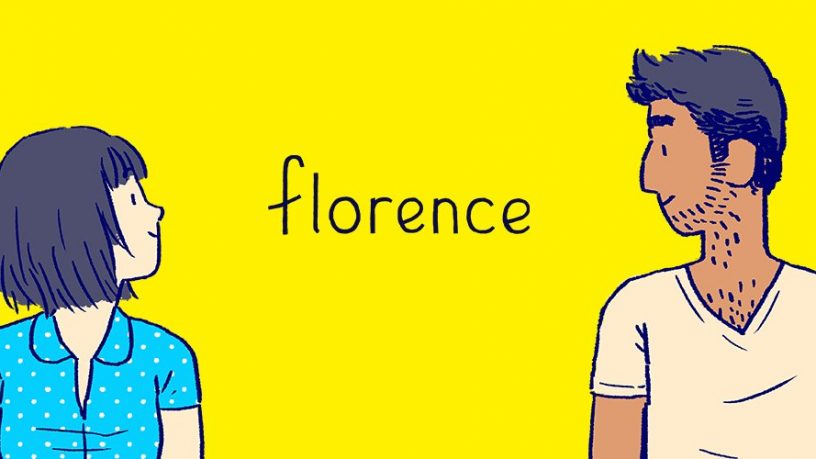
https://annapurnainteractive.com/en/games/florence
Entry by Kevin Ghouchandra
A. BASIC INFORMATION
Creator: Mountains (http://mountains.studio/)
- Ken Wong (Director)
- Kevin Penkin (Composer)
- Kamina Vincent
- Tony Coculuzzi
- Sam Crisp
Creation Technology: Unity
Publisher: Annapurna Interactive
Date of original release: 15 February 2018 (iOS), 14 March 2018 (Android), 13 February 2020 (Windows, macOS, Nintendo Switch)
ESRB Rating: T (Teen)
Platforms: Windows, macOS, Android, iOS, Nintendo Switch
Peripherals required: Keyboard and mouse (PC), speakers/headphones
Awards/Distinctions:
- The Game Awards 2018: Best Mobile Game
- New York Game Awards 2019: A-Train Award for Best Mobile Game
- 22nd Annual D.I.C.E. Awards 2019: Portable Game of the Year
- Game Developers Choice Award 2019: Best Debut (Mountains); Best Mobile Game
- 15th British Academy Game Awards 2019: Mobile Game
- International Mobile Gaming Award 2019: Grand Prix
- Italian Video Game Awards 2019: Best Mobile Game
- 2019 Webby Awards: Best Game Design
Version used for entry: Android 1.0.9
B. GAME INFORMATION
Game/eLit Genre(s): visual novel, puzzle
Time to complete: Main Story, 2 Hours; Completionist, 3 Hours (from https://howlongtobeat.com/game.php?id=4010)
Replay required/useful?: Not required. A single attentive playthrough will reveal the full story.
Gameplay: The game features very little text, with many tasks the player needs to perform being explained by a hand icon mimicking the basic direction/movement required. The gameplay enacts tasks that Florence is undertaking, such as matching numbers to simulate work, or coloring in a drawing that Florence is making. It also features some more abstract tasks meant to feed the player information about what is going on or how Florence is feeling, such as uncovering an image representing a character’s thoughts or words, or putting together puzzle pieces that form conversation bubbles, with the difficulty of the puzzle representing the difficulty in carrying on the conversation.
C. LITERARY INFORMATION
Related Literary Genre(s): Romance, Graphic Novel, Vignette/Episodic Fiction, Künstlerroman (“artist’s novel”), Ergodic Literature
Story/Plot Summary:
Florence Yeoh is a young Chinese-Australian woman who we first meet at 25. She works a routine desk job, and fends off her mother’s pressures to find a boyfriend. While cleaning up, she stumbles upon a drawing she made when she was seven. Florence looks fondly back on that time, when she was more social as opposed to her more solitary life now.
One day after her phone dies, preventing her from listening to music on her headphones while on a walk, she is drawn to a nearby sound, coming from a cellist playing on the street. Sometime later when biking, she spots the cellist walking by and in her distraction, crashes her bike. The cellist comes to check on her, and after talking more, he gives her his name (Krish) and phone number.
On their first date and subsequent dates, things go well and communication flows. Krish dreams of becoming a famous cellist and selling his music in the kinds of record stores the two peruse together. Florence feels like she has regained some of the happiness she lost since her earlier years. When Florence first visits Krish’s home, she finds an unsubmitted application to a music academy, and pushes him to follow his dreams and apply. During this time, Florence rekindles her passion for art. The two share many experiences such as exploring their city, meeting Krish’s family, and sharing in his passion for music.
One day, the two get into an argument at the grocery store. After a tense ride home, Florence and Krish make up, and bond over cooking together. Six months later, Krish moves into Florence’s place. On the day of Krish’s music academy audition, he gifts her a set of paints and a book to paint in, encouraging her to follow her own passion as she did for him. What used to be a solitary routine for Florence is now interspersed with new moments, the two cooking together, and Florence drawing Krish as he plays the cello.
A year later, things have grown routine again for Florence. Krish’s once joyous cello playing has turned into strained practice for the academy, Florence’s art is left by the wayside under the pile of life’s responsibilities, and the two don’t have many new experiences. They are focused on their own lives and begin to ignore their relationship. The two have another fight and begin to drift apart. Eventually, Krish moves out.
Florence feels fragmented following the break-up and after brushing off her mother up to this point, confides in her. One day she picks up the set of paints and begins to paint again. As she pursues art, she branches back out into the world, spending time cooking with her mother, joining a sketching club, and getting a cat. She opens a shop online to sell her paintings and starts to see success, to the point where she can quit her job and her pieces are placed in a gallery. She has been able to move on from her break-up and finds happiness in this new stage of her life.
Sustainability for teaching:
Florence can be taught alongside other work that deals with changes in life. The game looks at a period of Florence’s life that goes through a lot of transition, with her work, her emotional state, and her solitude. One thing that makes Florence’s exploration of change unique is its explicit depiction of how these changes can be interconnected with different parts of one’s life. Florence picking up her passion for art helps her make friends, leave her boring job, and move on from her break-up.
Florence looks closely at a romantic relationship and breakup, but takes a more realistic approach, without the ‘happily ever after’ mentality that ends romance stories when two people get together, or that fades into an assumption that they stay together indefinitely. At the start of Florence and Krish’s relationship, things are fresh, they go on exciting new experiences together, and take new steps in their lives with each other, such as pushing each other to pursue their art. What prefaces the breakdown in their relationship is that they stop focusing on it, settling into routine and paying too much attention only to their own lives. Communication becomes more disjointed which only hastens the breakup. Florence treats romance in a very true-to-life way that only employs the rose-colored-glasses approach only when Florence herself is looking through these glasses, and the slow reveal of what transpires after this phase of a relationship offers a mature take on romance.
It is also worth noting that due to Florence’s Asian-Australian background, her role as the protagonist reflects a contemporary east-asian experience and a break from more traditional western romance protagonists. Her relationship with Krish, who is of South Asian descent also allows this story to be read from the perspective of an interracial relationship.
Florence explores how gameplay can be used to create an affective response in the player. For Florence, the gamification of tasks evokes the emotions that Florence herself is feeling. At her most detached and listless, you do things like scroll through social media, match numbers for work, or other rote tasks, with almost entirely no colors. When she is more engaged, particularly in the first half of her relationship with Krish and when drawing or painting, the tasks are more visually interesting than numbers in white blocks or pressing a ‘like’ button repeatedly. This communicates how Florence feels about those parts of her lives, and are meant to influence how the player feels as well. When matching numbers for work in a gray office versus doing it for Florence’s art shop, the same activity evokes different reactions in the player. Several tasks throughout the game call back to previous ones, with different circumstances, letting the player feel the change in situations that Florence is going through.
D. Walkthrough
Florence is fairly straightforward in its progression, so rather than instructions for how to go through the game, this section will list things to watch out for while playing in order to get the most out of the experience.
Color: Pay attention to when the background and the interactive elements have color, versus being in grayscale. When scenes have a mix, consider what the game wants you to focus on. Some scenes transition between the two, which happens at important moments. Visual art is central to Florence’s journey, so consider how she uses it in her own art. Color is often linked to how Florence feels about herself and the world around her, so pay attention to when and what colors are used.
Music: Like many other games, music reflects the mood of a scene. Pay attention to the changes. Note the use of the cello in particular. There are also links between the use of music and color. Note how changes in music are aligned with color and visual impact onscreen.
Engagement/Challenge: Florence asks the player to complete a variety of small tasks, and players will respond differently to them. Pay attention to the emotional reaction you have to these tasks. If you feel a task is tedious or monotonous, is that what Florence herself feels? If it is an emotionally resonant task, why did that moment stick with you? How does the challenge or context of tasks change between instances? This is most evident in the conversation puzzle bubbles, which change in difficulty depending on how tense the conversation is, but which also applies to tasks like number matching, or cooking/eating-related tasks. More challenge isn’t always negative, it can also mean more engagement.
Motion: Think about the motions that you are asked to do and how abstracted they are from the actions being depicted. What themes are at play throughout the game as the player is asked to act out both the everyday and the unusual events of Florence’s life. Motion is often connected to progression and time. Why are certain tasks interactive and other just depicted? How does making the player do that task convey the intended feeling? Consider the rare times that the game performs motions of its own on the interactive elements, and how that changes the task. Pay attention to the times that the background includes motion, such as rain, and why the game has strayed from its usual static environments.
Callbacks: Florence will remind players of past events or present certain tasks again though under different circumstances. Pay attention to when a task or event is brought up again, noting the changes between each instance. Consider how repeating certain tasks emphasizes positive or negative feelings around the changes in circumstances, or reflects constants in Florence’s life.
E. SOURCES AND RESOURCES
- Wikipedia Entry: https://en.wikipedia.org/wiki/Florence_(video_game)
- Metacritic Critic Reviews:
- YouTube gameplay video (Joshiball): https://youtu.be/c0Hmvev5r7A
- Annapurna Interactive, “The Making of Florence.” YouTube, 27 April, 2018.
- Jacob Geller. “The Intimacy of Everyday Objects.” YouTube, 5 August 2020. (Geller discuss Florence at time index 14:58)
- People Make Games. “Investigating Three Indie Superstars Accused of Emotional Abuse.” YouTube, 18 March 2022.
 Stories in Play