
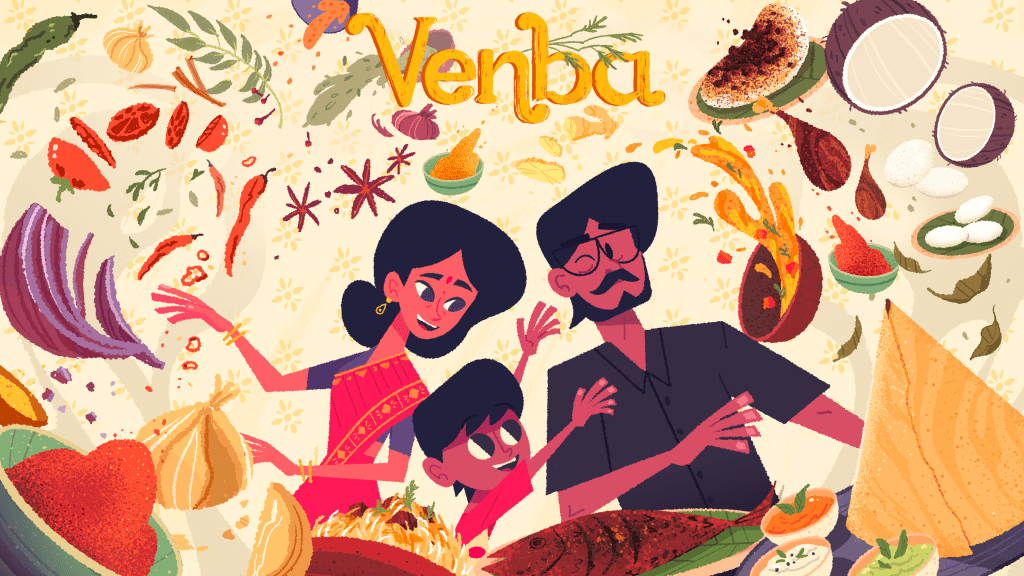
Entry by Leila Kazeminejad
A. BASIC INFORMATION
Creator(s): Visai Studios
- Abhijeeth (Abhi) Swaminathan (Lead Programmer, Designer, Writer)
- Shahrin Khan (Producer and Writer)
- Tatsuya Morita-Ahad (Programmer)
- Sam Elkana (Art Director)
- Rae Minos (Gameplay Artist)
- Danik Tomyn (VFX Artist)
- Nathan Pilla (UX Designer)
- Jason Roy (Character Designer)
- Cecile Richard (Logo Designer)
- Divya Vivekanandan (Recipe Designer and Food Consultant)
- Sashi Lavanya Appavuraj (Food Consultant)
- Vignes Ravi (Food Consultant)
- Alpha Something (Music Composer)
- Neha Patel (Sound Designer)
- Lynn Alexandria Morgan (QA Lead)
- Jace Hijazi (QA Lead)
Creation technology: Unity
Publisher: Visai Games
Date of original release: 31 July 2023
ESRB Rating: T (Teen) – Blood, violence, use of tobacco
Platforms: PC, Nintendo Switch, Playstation 5 (PS5), XBox Series, XBox One
Peripherals required: Keyboard and mouse (PC), speakers/headphones
Awards/Distinctions:
- 24th Game Developers Choice Awards: Social Impact Award
- Independent Games Festival: Seamus McNally Grand Prize
- 20th British Academy Games Awards: Debut Game
Version used for entry: PC
B. GAME INFORMATION
Game/eLit Genre(s): Visual Novel, Cooking Simulator/Puzzle.
Time to complete: Approximately 2 hours (including all dialogue options in Chapter 3 and Chapter 7).
Replay required/useful?: Not required. There are no other alternative plot lines or endings.
Gameplay: Using the left mouse button, the player ‘clicks through’ the dialogue of the characters of the story. The dialogue options do not affect the story’s course or outcome. When a phone screen is displayed showing text messages, the player can hold the left mouse button and move the mouse up and down to scroll the messages. The back arrow on the phone’s screen can be clicked to turn the phone screen off.
During cooking puzzles, the player uses the left mouse button to point, click and drag various cooking vessels/tools and ingredients to move and combine them. To complete the puzzles, the player must successfully combine the ingredients in a specific sequence using the particular cooking vessels/tools provided. If a step is done incorrectly, the player starts over from the previously accomplished step. If available, the player is prompted to click the cookbook icon on the top right of the screen to see an incomplete recipe. It indicates the steps in the sequence of the cooking puzzle using a combination of words and diagrams. If the player is unsure how to proceed, a button with a question mark is located on the bottom-centre of the screen. Clicking the question mark provides additional hints for the player to complete their current step in the puzzle.
C. LITERARY INFORMATION
Related Literary Genre(s): Migrant fiction/non-fiction; Diasporic fiction/non-fiction; Food writing; Women’s/Feminist fiction/non-fiction; Social problem fiction.
Story/Plot Summary:
Notes:
- Some dialogue options have not been included in the summary as they do not offer new information.
- All “Cooking Puzzles” referenced are covered in section D. Walkthrough.
- ‘Amma’ means ‘Mother’; ‘Appa’ means ‘Father.’ Both are Hindi words. For the sake of the plot summary, Amma and Appa will refer to Venba’s mother and father unless in dialogue where Kavin is addressing either Venba or Paavalan.
Chapter 1
The year is 1988, and the player is introduced to Venba and her husband, Paavalan, Indian immigrants living in Toronto, Canada. Venba is sleeping on the couch when she is awakened by Paavalan, who is getting ready for work. Although she is feeling ill, Venba asks Paavalan what he will take for lunch, and after he dismisses her suggestions that he make idlis, a savory rice cake, as ‘too complicated,’ she decides to make the dish herself using her Amma’s recipe from a worn-out and semi-destroyed cook book to guide her (Cooking Puzzle 1). After Venba makes the idlis, Paavalan is pleased to see that Venba has decorated the idlis with their faces. He also tells Venba that she didn’t need to cook for him, and that he would have been fine “starving” for the day. Venba points out that she would not have had anything to eat either and that Paavalan should be able to cook simple dishes like idlis. The couple discuss returning to India as they have been struggling to assimilate into Canadian culture, and stable employment has been difficult to attain. Once Paavalan leaves for work, Venba heads to the doctor’s office. After she gets ready for the day, she cooks more idlis. Paavalan comes home and informs Venba that he was unable to secure full-time work at his job and wants to continue discussing their move back to India. However, Venba tells Paavalan to eat lunch first, at which point he sees three, instead of two, idlis with smiling faces, indicating the cause of her illness: she is pregnant. The scene then cuts to Paavalan and Venba in bed, discussing whether to return to India or to stay in Canada for the sake of their child. Although they are nervous, they believe that staying in Canada will give their child a better life.
Chapter 2
In 1994, Paavalan is on the couch, talking on the phone. To differentiate the language being spoken, English text is coloured yellow and Tamil text is coloured white. In the background, Venba admonishes their son, Kavin. While Venba speaks Tamil, Kavin responds in English, sometimes with his dialogue box dotted with black spots, illustrating Venba and Paavalan’s difficulties in following Kavin’s English. As Paavalan discusses his work experience and his qualifications over the phone, he frequently asks the interviewer to repeat themself. After the interview, Paavalan shares that he did not get the job. Despite having a Bachelor of Science in Physics, Paavalan used to be a writer in India. With his imperfect English, Paavalan knows that he will be unable to work as a writer in Canada. He wonders if watching cartoons with Kavin will help him learn English and gain a better understanding of Canadian culture. Venba counters with her fears that the now five year old Kavin, whose friends call him Kevin, may not be able to speak Tamil. Kavin states that he prefers being called Kevin despite Venba telling him that his name means “beautiful” and should be easy for Canadians to pronounce. Paavalan replies that Kavin is adapting well to Canadian culture and is pleased that his son earned a good grade on his English test. To celebrate this achievement, Kavin requests pizza. Venba and Paavalan instead suggest various Tamil dishes such as parotta, idiyaapam, biriyani, and many types of dosa. When Kavin refuses these suggestions, Venba says that they should make puttu, a dish made of ground rice and coconut shavings that looks like a rocket launching. Intrigued, Kavin agrees and all three of them make puttu together (Cooking Puzzle 2). Once the puttu is done, we see a letter addressed to Venba, rejecting her application to be a full-time teacher. In bed, Venba and Paavalan discuss their employment troubles. Behind on the rent and unable to send money back to India, Venba suggests that Paavalan take a sales job at their acquaintance Suresh’s company. While Paavalan is at first reluctant, he recognizes the necessity of doing so. Venba also shares her challenges teaching in Canadian schools as she feels there is a “wall” between her and her students. She fears that Kavin, too, is building a wall between them since he appears to reject his Tamil roots by not speaking Tamil and not eating Tamil food at school. Paavalan tells Venba that although Kavin is not growing up fully immersed in Tamil culture, he is receiving a good education and will have more opportunities in Canada than in India. Paavalan urges Venba to accept that Kavin is growing up more Canadian than Tamil.
Chapter 3
In 1995, Kavin is on the phone with a coworker from Paavalan’s sales job. Paavalan is late returning home from work and Venba is worried. Insecure about her English, Venba stands behind Kavin and prompts him with specific questions to ask. Kavin asks about Paavalan’s attendance that day and whether his father has left for home yet. The coworker recalls that Paavalan is usually very quiet and largely alone at work which is why she doesn’t know where he is specifically. The coworker informs Kavin that the sales staff left a while ago at 5 p.m. Venba and Kavin look for Paavalan in the park, following Paavalan’s regular route when he doesn’t take the bus. As they walk, Venba tells Kavin that he can ask her any question he wants if he can ask in Tamil. Kavin asks Venba why Paavalan’s coworker said he was quiet when he talks a lot at home. Venba says that Paavalan is probably quiet because no one talks to him and that he doesn’t like his job. Kavin asks if Paavalan liked being a writer and Venba says that Paavalan loves writing, but now only writes when something is bothering him. The player is given the option of having Kavin ask one of two different questions:
1. “So… how did you and appa meet?”
Venba tells Kavin that her name is a type of poem, similar to a haiku. When Venba was teaching in India, she was part of a protest for poor working conditions. Paavalan reported on the situation. Rather than writing an article, he wrote a venba. The poem received a lot of attention which led to eventual changes in the school. Venba fell in love with Paavalan.
2. “What did you do back home?”
Venba tells Kavin that she was a well-liked and successful math teacher for students in grades 9-12. She tells Kavin that although she is a teacher in Canada, her experience here is different, although she does not explain how.
Once Kavin has asked either question 1 or 2, the player is given two other dialogue options as Kavin:
1. “Why did you move here?”
Venba tells Kavin that because she and Paavalan wanted to be together they had to leave India, since many people were against their union. They decided to have a fresh start in Canada.
2. “Do you think you’ll ever go back?”
Venba says that she would love to go back to India eventually, but not in the near future since Kavin is still too young.
In the park, Kavin and Venba find Paavalan on a bench and see that he has been assaulted; his glasses are broken. Once they are home and Kavin is asleep, Paavalan starts writing in his journal.
Chapter 4
In 2006, Kavin graduates from high school and and Venba decides to make layered biriyani to celebrate before he leaves for university (Cooking Puzzle 3). While cooking, Venba is guided by the memories of her Amma making her layered biriyani. She recalls how expensive the ingredients are in Canada. Once Venba finishes cooking and serving the biriyani, Venba asks Kavin how it tastes and discusses their planned drive to Kavin’s university. Kavin informs Venba and Paavalan that his friends offered to drive him instead. Although Venba tells Kavin that she and Paavalan are happy to drive him and spend one last day with him, Kavin insists on going with his friends. Venba then says that she has packed him multiple Tamil/Indian dishes for him to eat at university. Kavin rejects the home-cooked meals, saying they smelled and that he wanted to be “normal” for once. Paavalan tells Kavin that he hopes Kavin is not rejecting Tamil culture because he is being influenced by other people. Kavin leaves with his friends and Venba and Paavalan are alone again. In bed, Venba is ruminating over Kavin’s rejection of Tamil culture and says she is “done” with Kavin. Her anger quickly dissipates when Paavalan lies and says that Kavin forgot his headphones to which Venba responds by suggesting they drop them off for him at his university. Paavalan reflects on how happy he is that Kavin is pursuing writing, yet his excitement is dampened with doubts about whether Kavin will be able to read, let alone understand, the Tamil writing that has inspired and informed Paavalan’s writing. He is unsure if Kavin remembers the stories Paavalan told him in his childhood, and worries that he is rejecting Tamil culture because he remembers that Paavalan was assaulted for being different. Paavalan contemplates whether coming to Canada was a mistake since he is unable to write, Venba is unable to teach, and Kavin is not comfortable being Tamil. Venba says that she does not regret the choices she has made because she has both Kavin and Paavalan.
Chapter 5
In 2014, the player is shown a picture of a young Paavalan, with his mended glasses sitting in front of the frame, implying that Paavalan has passed away. Venba is sitting on the porch when she gets a notification on her phone. She begins to cook a great feast of murukku (a fried dough the shape of a spiral), inippu paniyaram (a pan-fried dumpling), pomfret fish, rasam (a soup), mutton kuzhambuand (a stew-like dish), and chicken fry (Cooking Puzzle 4). After cooking, Venba waits until it is dark outside. She receives a text from Kavin whom she was expecting for dinner. He tells her he is too busy to come and has to cancel their plans. The apartment is dark with Venba alone on her side of the bed. Her application for full-time work as a teacher has been finally approved.
Chapter 6
In an unspecified year between 2014 and 2017, Kavin is shown holding up a blue mask that has consistently appeared as a decoration in his family’s home throughout the game. Kavin is texting a work colleague named Kris Kendall about a scene in their TV show, “The Melting Pot.” Kris messages Kavin approvingly regarding the blue mask; Kavin responds that the mask is not a traditional Tamil decoration although Paavalan liked to have it displayed in the house. Kris begins a discussion over a school lunch scene in which the character, Priya, brings a Tamil dish for lunch to demonstrate cultural diversity within the show. Kris suggests a few typical Indian dishes, but Kavin rejects them as not being specifically Tamil dishes. Kavin suggests that Priya be shown eating nothing as he remembers being embarrassed to eat lunch at school. Kris rejects this suggestion as it does not “fit the tone of the show” which aims to celebrate different cultures. Kavin then writes a text explaining that he is uncomfortable with not addressing the fraught nature of school lunches for some children of immigrants. But he deletes the message and accepts Kris’ request to find an authentic dish from Amma’s recipe book. While perusing the patched-up book, Kavin attempts to make chicken rasam which he remembers eating when he was sick (Cooking Puzzle 5). Although Kavin cannot read Tamil well, he remembers recipes that the player has made throughout the game as well as moments in his childhood. As Kavin cooks the chicken rasam, he recalls one time he was sick and how Venba was upset that day. He remembers her getting a call from her Appa regarding her Amma. She was sad and regretful that she was unable to go back to India to see her ailing Amma. He recalls Venba promising to send money to her parents despite her Appa’s protests. Further in the cooking process, Kavin remembers that Amma passed away. When Venba explained death to Kavin, he promised his mother that he would be there for her. Kavin begins to feel regret at the distance between himself and his mother.
Chapter 7
In 2017, Kavin is in India visiting Venba and learning how to make three different kinds of dosa from Venba: plain dosa (a type of flatbread), oothappam (vegetable-filled dosa), and kari dosa (meat-filled dosa) (Cooking Puzzle 6). While first hesitant and afraid to make mistakes, Kavin becomes more confident and successfully makes the three different dosas. Venba says that Kavin could run a great dosa shop back in Toronto; Kavin agrees. He tells Venba that he will finish making the dosas while she eats, but she protests that they will get cold by the time he sits down to eat them. Kavin says they will be cold for her, too, so he urges her to eat first for once. Afterwards, Kavin and Venba are sitting outdoors on a balcony; he shows Venba Amma’s cookbook and the few recipes he has restored in Tamil. When Venba questions if he did it for his job at “The Melting Pot,” Kavin reveals that he quit his job. Kavin has two dialogue options:
1. “I couldn’t write what they wanted.”
Kavin tells Venba that the show was trying to offer a simplified view of the complexities of his life and culture as the child of immigrants. He began feeling like a fraud since he had spent most of his life rejecting Tamil culture, but was expected to behave like an expert for the show.
2. “I felt like a fraud.”
Kavin states that he worked as a consultant on Tamil culture for the show but felt guilty for doing so after having spent his childhood rejecting his culture.
Venba has two dialogue options in response to Kavin although they both result in the same response from Kavin.
1. “You’re being unfair to yourself.”
2. “I had no idea you felt this way.”
Kavin expresses regret that he was not there for Venba after Paavalan died, especially since he knows she stayed in Canada for him. He realizes that it must have pained her to return to India because Kavin was so distant with her. Kavin expresses his feelings of guilt for not appreciating Venba and Paavalan enough. He says that Paavalan inspired him with his writing and his stories, even as a child. Kavin lays his head on Venba’s lap and Venba says that she came back to India because it was best for her and Kavin. Kavin asks if she will go back to Canada and Venba says she does not know; however, the moment they are enjoying feels good. Kavin agrees.
Suitability for Teaching: Venba‘s plot and gameplay combine to contribute to conversations in the fields of diasporic/migrant literature, game studies, critical food studies, and women’s studies. Taking the perspective of the first-generation immigrant, lead programmer, writer, and designer, Abhi expresses how immigrants in the 1980s to 1990s were largely older individuals, uprooting established careers, social lives, and familial units, to migrate to a “strange new country,” most likely alone (Ore). Feelings of isolation and displacement are common in diasporic literatures, as well as feelings of nostalgia for an imagined or actual home. The longing for “food from home”, for instance, is felt alongside a refracted, imperfect memory of home (Mannur 27). This imagined fantasy serves as an “intellectual and emotional anchor” that gives “a sense of rootedness” to the immigrant in their new, foreign location (27). Within Venba, the story reminds the player of India through food and culture, but also through feelings of longing, contemplation, and regret. Venba and Paavalan continuously question the presence of their family in Canada. Despite the discrimination they would face in India because of their relationship, Venba and Paavalan imagine that living in India would solve their problems as they could find emotionally fulfilling employment while raising Kavin in his own culture. Food is a nostalgic lens that can illustrate how India is idealized in the face of unfamiliarity and challenge, yet food also offers a small comfort to Venba and Paavalan to make life in Canada bearable. Although they are not “naturalized” (Radhakrishnan 122) Canadian citizens, cooking Tamil food provides Kavin with a connection to India through the kitchen.
Diasporic/migrant literatures often grapple with first-generation and second-generation immigrants’ struggles with preserving their cultural and ethnic identities. Despite Venba’s uniquely Tamil perspective, the game is universally relatable as a story of the experience of immigrants and their children. In Venba, Kavin is considered a naturalized Canadian because he grew up in Canada, learning Canadian culture and values. While Venba and Paavalan attempt to teach Kavin Tamil language, culture, and cuisine, they insist that their son is both Canadian and Indian despite his lack of connection to India itself. Ultimately, Kavin leads a “double life,” (122) “‘in between’ the nostalgic world of [his] first-generation parents on the one side, and the dominant assimilationist culture of the receiving country on the other” (Maghbouleh 200). For Kavin, being marked as Indian by his food causes him to reject Tamil cuisine in an attempt to be accepted as Canadian rather than as Indian-Canadian. Kavin later regrets rejecting Tamil culture, and, like Venba, his relationship to India becomes a nostalgic one.
Game studies scholarship observes that games centred on food are often categorized as “cozy games” (Waszkiewicz x), possibly due to the consumption of food being a universal experience and the tendency of food games to incorporate vibrant colours. Critical food studies scholarship provides a useful context for understanding why Venba, as a story about the immigrant experience, is told through the genre of the cooking game. According to Anita Mannur, “Food, as a central part of the cultural imagination of diasporic populations, becomes one of the most viable and valuable sites from which to inquire into the richly layered texture of how race is imagined and reinterpreted within the cultural arena, both to affirm and resist notions of home and belonging” (8). In Venba, while the gameplay clearly emphasizes the importance of making food, the plot evokes questions regarding the concept of home, authenticity, ethnicity, nostalgia, and assimilation.
Women’s studies provides another lens through which Venba can be studied. Critical food studies, as noted by Waszkiewicz, has been largely theorized by women, racialized, queer, and differently-abled scholars; therefore, food studies involve an intersectional approach (Waszkiewicz x). In particular, insights from critical food studies can be applied to the role of the title character of Venba, who feels it is her duty and whose self-identity as a wife and mother is bound up in her making meals for her family (Mannur 31). We see how the game’s premise is built upon Venba’s role as the reproducer of culture and how Kavin’s eventual embrace of Tamil culture comes largely from his nostalgia for Venba’s home-cooked meals. Cooking games are usually gendered female in terms of their target players. Within game studies, the role of gender in gaming culture is discussed by Shira Chess in Ready Player Two: Women Gamers and Designed Identity: female players are imagined entirely in opposition “to [the] interests, desires, and game styles” of male players (Alfrey 423). Female players are also “expected to have limited time for leisure, and assumed to find [their] primary fulfillment through consumption and caregiving” (423). Casual games such as Venba are appealing to a wide audience of gamers who may be older, differently-abled, or simply enjoy story-rich games. In theory, games targeted towards women are observed to be casual, short in length, have managerial tasks and a low-risk of failure, vibrantly coloured with soft shapes, and low violence (Waszkiewicz 48-49) all of which Venba adheres to with its minimal run-time, its focus on cooking, home, and family, and the way in which it allows the player to make mistakes without repercussion. By looking through the lens of women’s studies and assuming Venba is targeted towards women, we can see that it reinforces gendered expectations of women “to reproduce culture and national identity,” (Mannur 30) and it demonstrates how games can make cultural assumptions that “[reflect] back to women in the very products meant to entertain and to provide imaginative relief from the limits of everyday life” (Alfrey 423).
Whether or not Venba is targeted towards women players, women’s studies sensitizes the player to the role of gender and how it affects both the plot of the game and how gameplay can produce real-life effects. Kavin’s characterization challenges some of the gender stereotypes portrayed throughout Venba. Although Venba and Paavalan’s marriage followed patriarchal norms with Venba primarily responsible for meal preparation, eventually Kavin learns to cook to preserve his connection with his mother and his Tamil background, willingly taking on what his father considered a traditionally female role.
Ultimately, although the story Venba offers is fictional, the focus on food and how it evokes larger conversations about the immigrant experience, racism, and even media-multiculturalism is relatable to migrant and diasporic populations. For example, Reddit user u/Retroid_BiPoCket in their review states that: “It’s not often I get to experience media that’s for me. Media that makes me feel so seen and heard. There’s something very particular about being an immigrant – you walk in both worlds but belong to neither. Going back to India people can tell I’m a foreigner and treat me as such. And here in Canada, I have always and always will experience racism, colorism, and discrimination.”
Example texts that could be taught alongside Venba include Crying in HMart by Michelle Zauner, Maman’s Homesick Pie: A Persian Heart in an American Kitchen by Donia Bijan, and Climbing the Mango Trees: A Memoir of Childhood in India by Madhur Jaffrey. While these texts are non-fiction, they share similar narratives of diasporic/migrant individuals that emphasize the relatability of displacement and the illusory nature of home, the role of food, and the perspective of women. The gameplay of Venba relates to these texts in that it demonstrates to the player how emotions and food intertwine to create the complicated bonds between author, family, and culture as seen in food memoirs. As stated by Waszkiewicz, “Venba is certainly a unique [game] due to the meaning it attaches to the process of cooking, framing it not only as a crucial source of cultural and personal memory but also as an activity that is important for both the characters and the players. By contextualizing the food players prepare, it engages the player in play on emotional levels” (54).
D. WALKTHROUGH
Note: For brevity, the walkthrough only discusses the recipes found in each chapter and provides steps on how to complete each one.
Chapter 1 – Idlis
Cooking Puzzle 1
These are made during the opening scene. Venba says that her mother’s recipe for idlis are softer than her own and they cheer her up when she is sick.
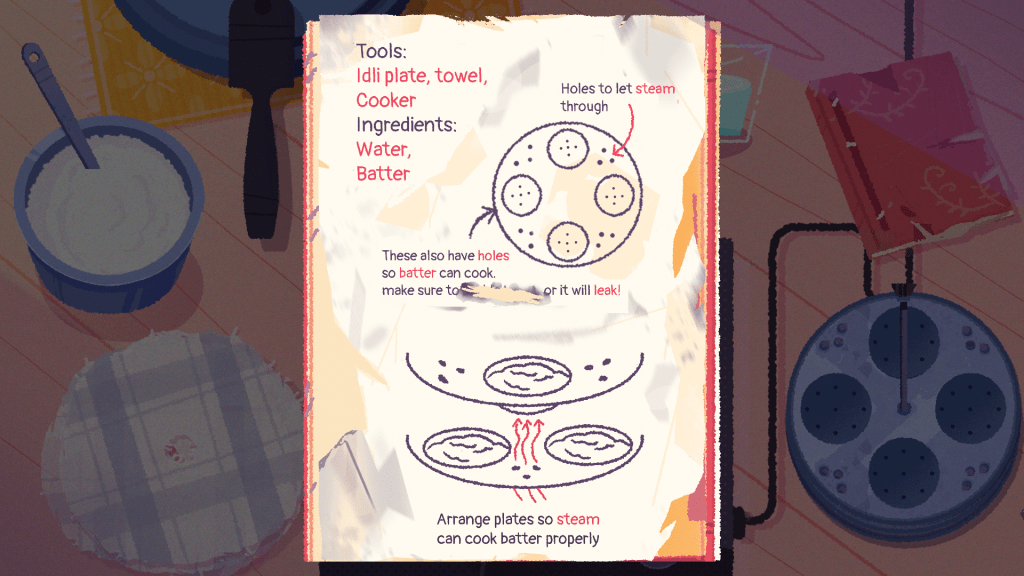

Amma’s recipe for idlis:
- Click the cookbook icon to access the basic instructions (top right). This step is available when the book icon is outlined in white. This step is available in almost all recipes.
- Add the water to the pot in the centre of the screen.
- Place one towel on an idli plate.
- Add idli batter to the idli plate.
- Place the idli plate in the pot.
- Rotate the idli plate so that the four circles are pointing north east, north west, south east, and south west (as seen in the picture above).
- Repeat steps 2-5 for the remaining idli plates and idli batter.
- Cover the pot with the lid located on the top left of the screen and turn on the stove by clicking the dial located at the bottom right of the hot plate.
Chapter 2 – Puttu
Cooking Puzzle 2
These are made after Kavin asks for pizza.
Making the puttu flour:
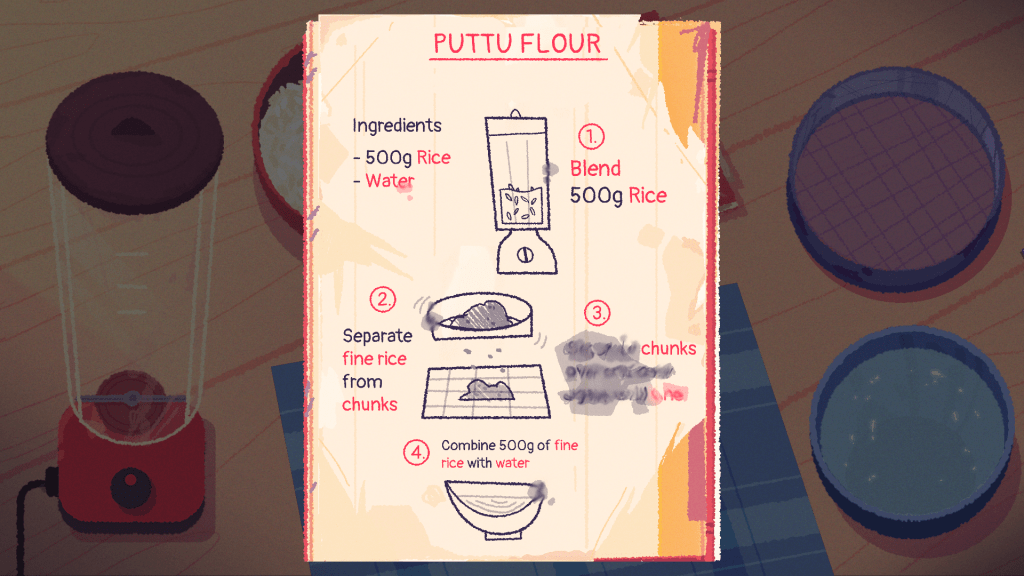
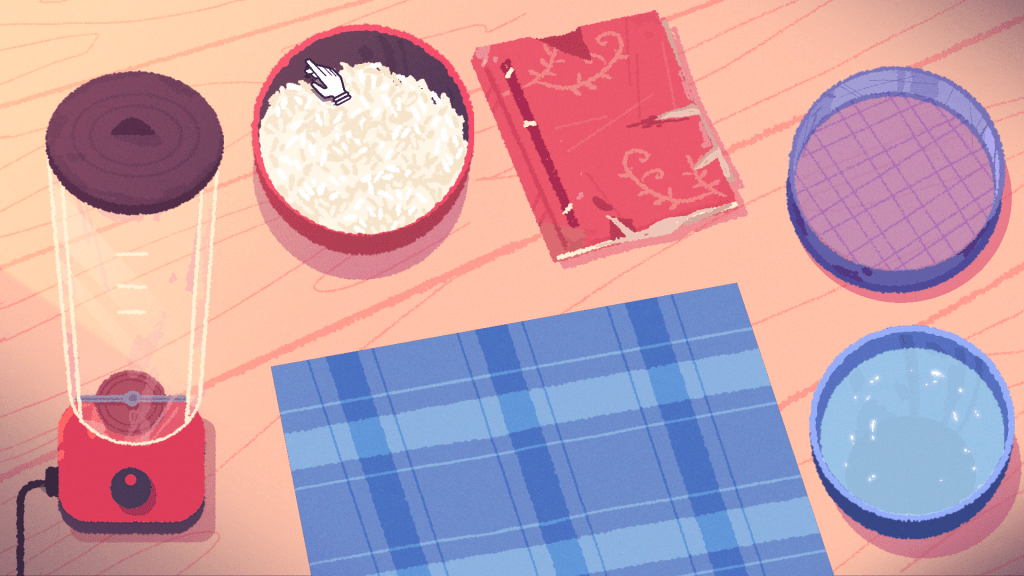
Amma’s recipe for puttu flour:
- Drag the soaked rice to the blender located on the left of the screen.
- Click the blender to blend the rice.
- Put the blended rice (now in the red bowl) in the sieve.
- Drag the sieve to the cloth in the centre of the frame and shake it over the towel by moving your cursor side to side while holding the left mouse button.
- Add the remaining clumps in the sieve to the blender.
- Repeat steps 2-5 until no clumps remain.
- Add the blended rice to the bowl of water.
Making the puttu:
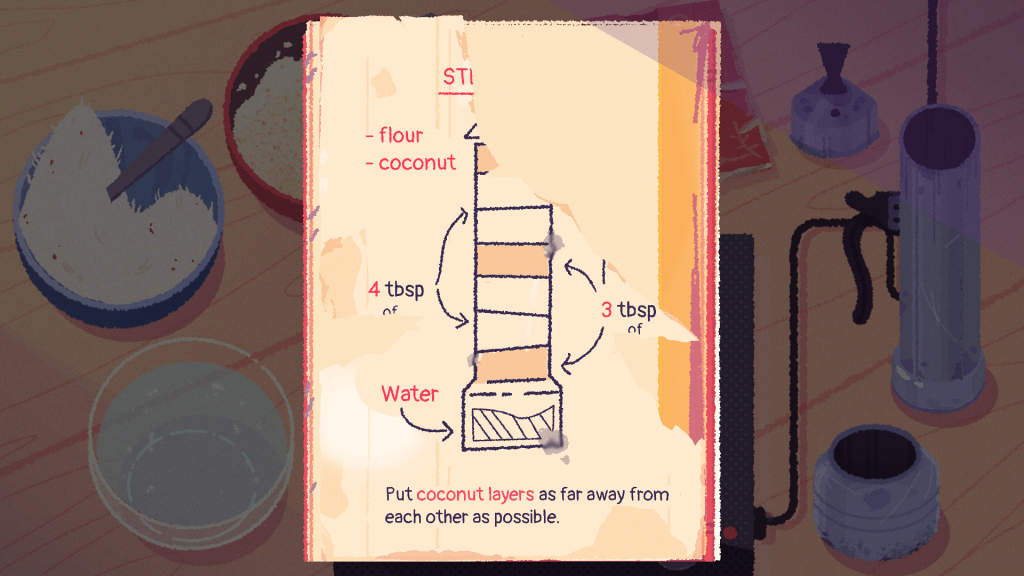

Amma’s instructions for assembling the puttu:
- Put water in the puttu kettle and drag the kettle to the middle of the stovetop.
- Fill the mold with one layer of coconut flour, two layers of puttu flour, one layer of coconut flour, two layers of puttu flour, and then one last layer of coconut flour.
- Put the lid on the mold and put it on top of the kettle.
- Turn on the stove using the dial on the bottom right of the stovetop.
Chapter 4 – Layered Biriyani
Cooking Puzzle 3
This recipe is made to celebrate Kavin graduating and going to university.
Making the biriyani gravy:
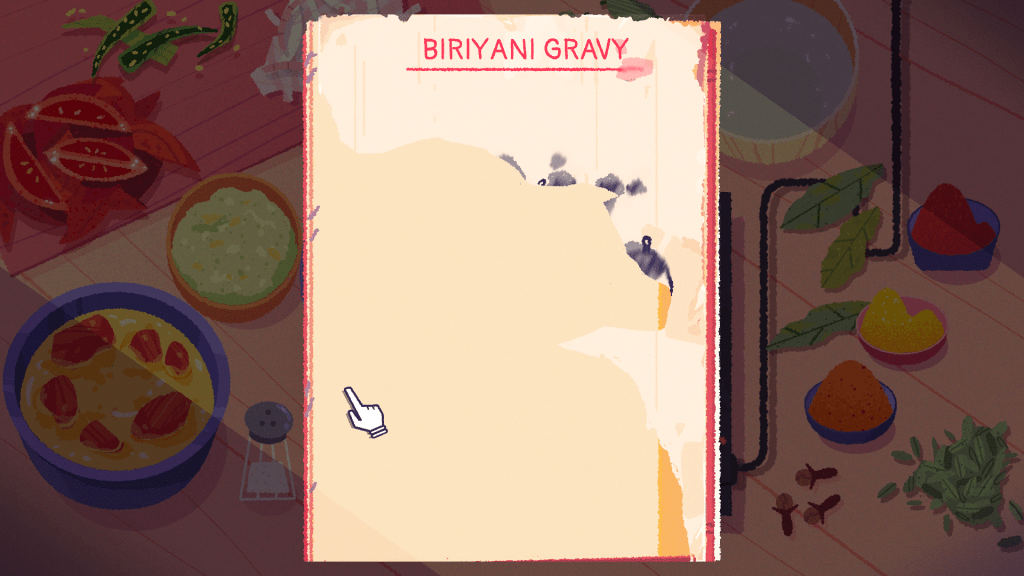

Amma’s biriyani gravy recipe is completely illegible. It’s creation relies on Venba’s memories:
- Add the whole spices first (bay leaves, cardamom, fennel seeds, cloves) to the pot to toast them.
- Add onions, chillies, ginger-garlic paste, and then tomatoes to the pot (ensure the tomatoes are last).
- Add salt, biriyani masala, turmeric, and chili powder to the pot.
- Add the marinated beef and then the water.
Assembling the layered biriyani:
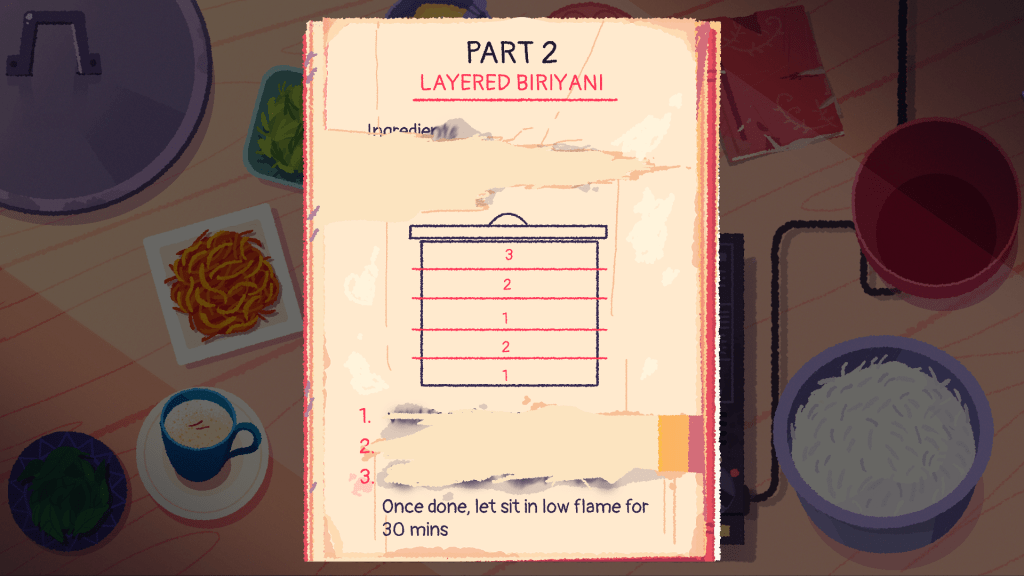
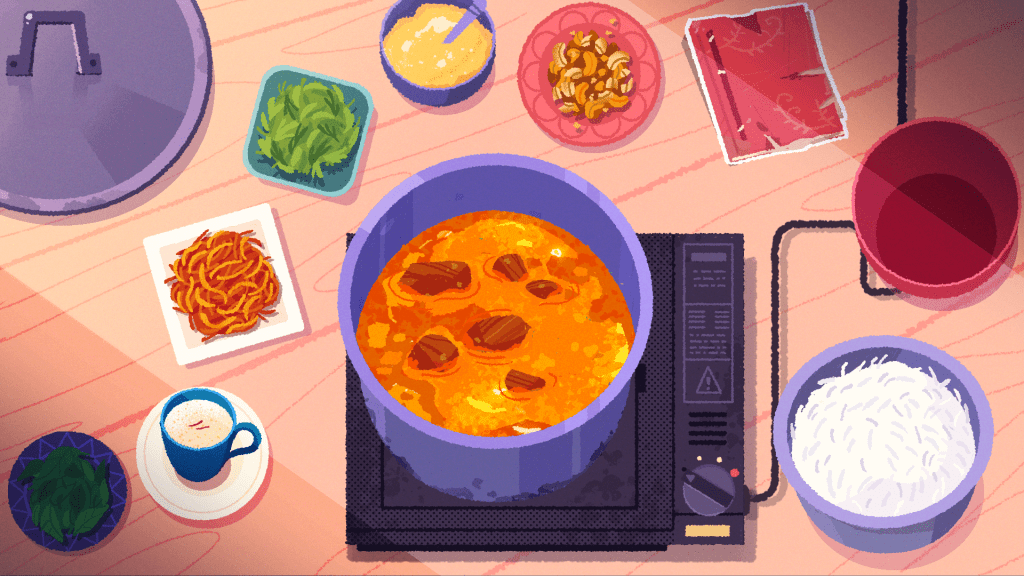
Amma’s instructions for assembling the layered biriyani:
- Using the red bowl on the top right, drag it to the pot to scoop out half of the biriyani gravy.
- Add the rice, the biriyani gravy, and then the rice again.
- Add ghee, saffron milk, mint, cilantro, fried onions, and cashews on top of the layered biriyani.
- Cover the pot with the lid located on the top left of the screen.
- Remove the lid after Venba’s dialogue by clicking on the lid.
Chapter 5 – A Feast
Cooking Puzzle 4
Venba creates a feast for Kavin after he promises to visit home.
Murukku

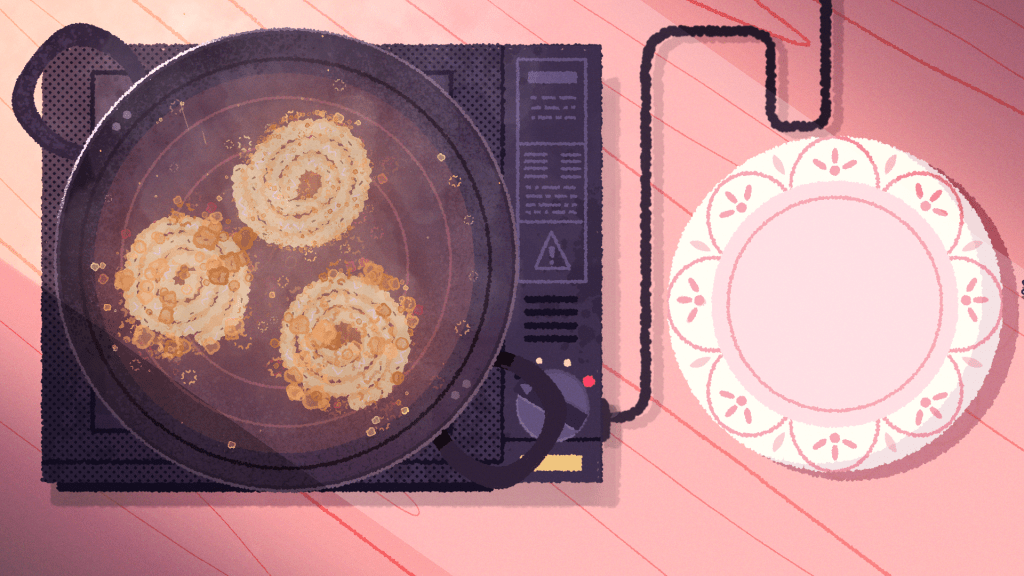
- Move the mouse in a circular motion to pipe the shape of the dough.
- When the murukku dough is frying, click them when they are golden brown and a white outline surrounds them to remove them from the pan.
Inippu Paniyaram/Sweet Paniyaram
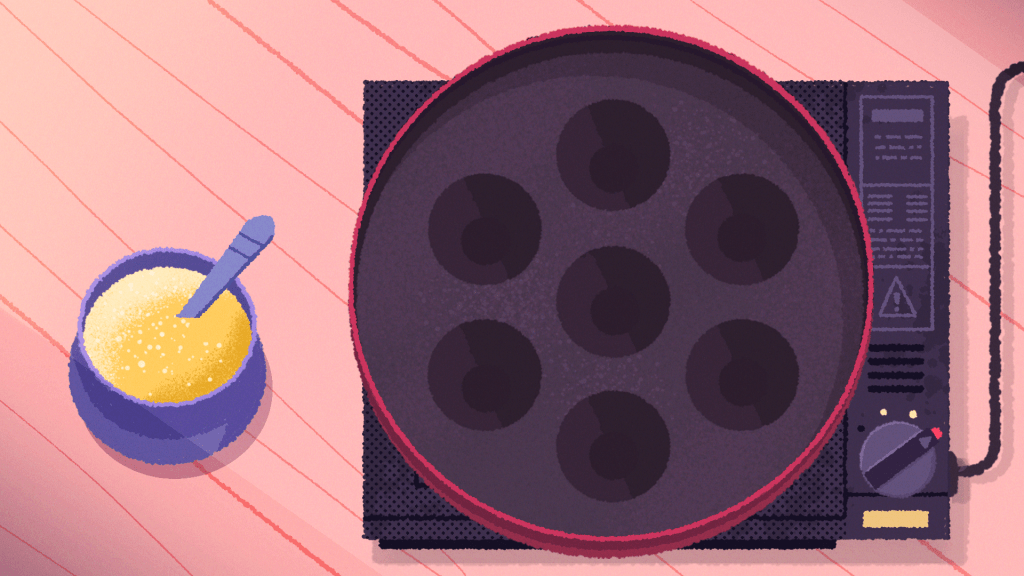
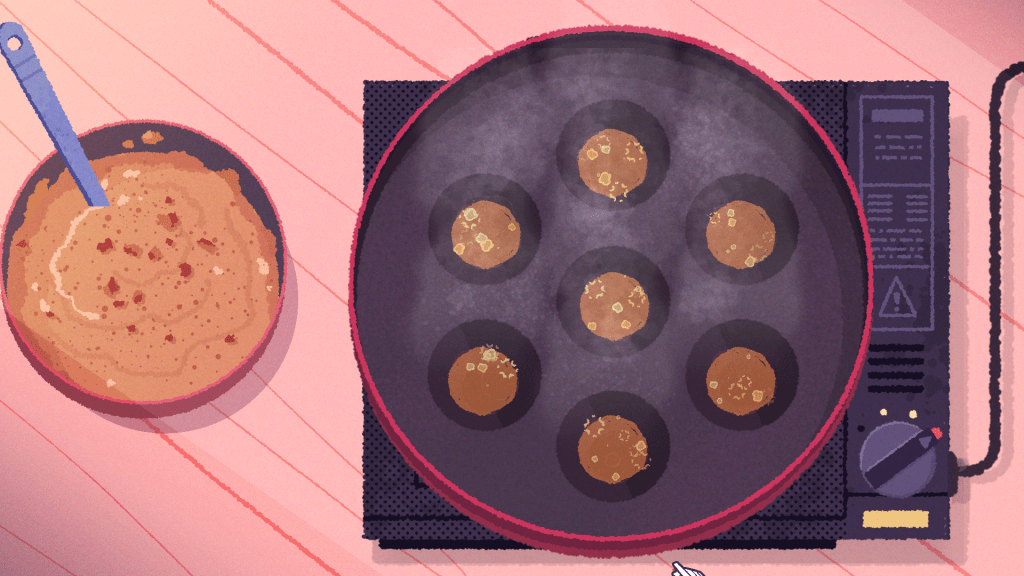
- Hold the left-mouse button and drag spoonfuls of ghee to the circular divots on the pan.
- Add in the inippu paniyaram/sweet paniyaram batter to each circular divot.
- When a white outline appears around one of the mounds of batter, click it to flip the dumpling.
- When a white outline again appears around a dumpling, click it to take it out of the pan.
Pomfret Fish
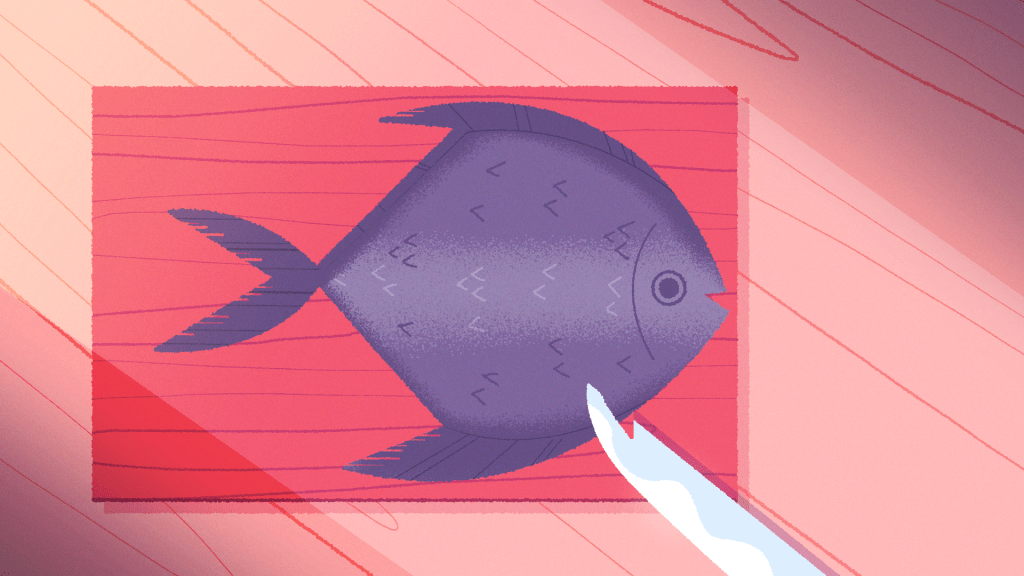
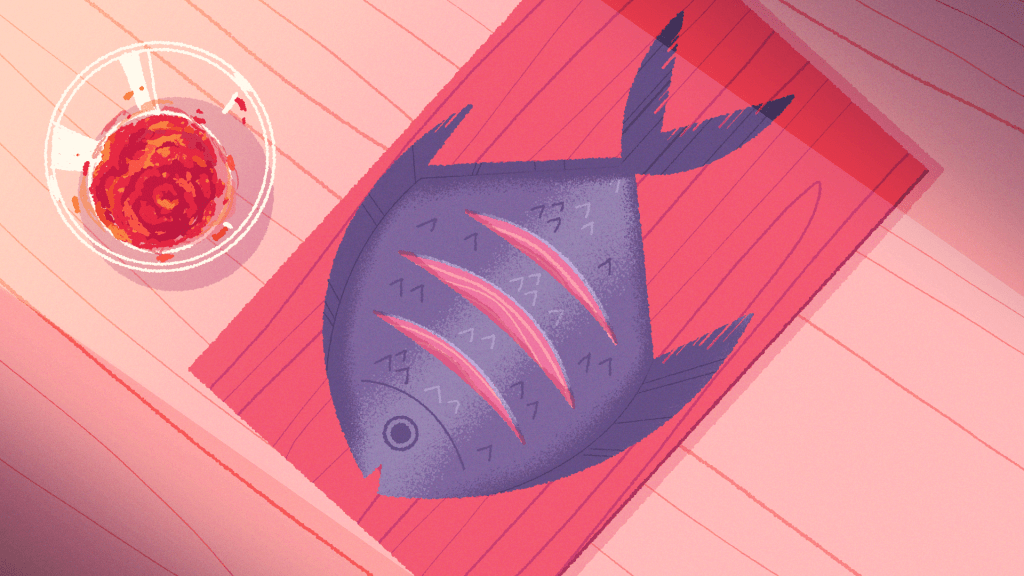
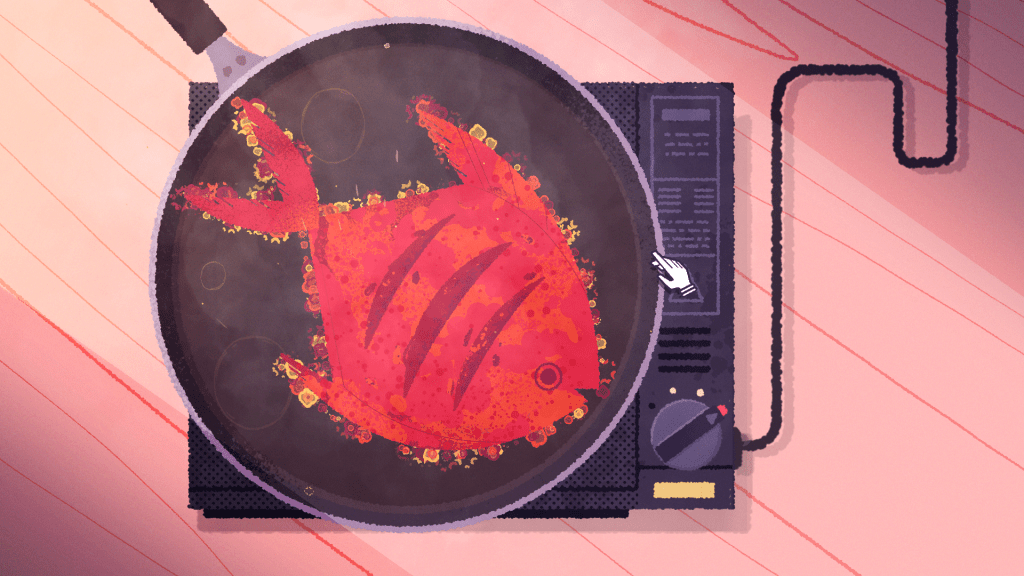
- Click the left-mouse button to score the fish with the knife on both sides.
- When the bowl of red paste appears, drag it over both sides of the fish to spread the paste over the fish.
- In the pan, click the fish to flip it when a white outline appears. Do this twice.
Rasam Oil

- Add ghee to the small pan.
- Add all spices and ingredients to the pan in the order in which they are presented by clicking the ingredient.
Mutton Kuzhambu
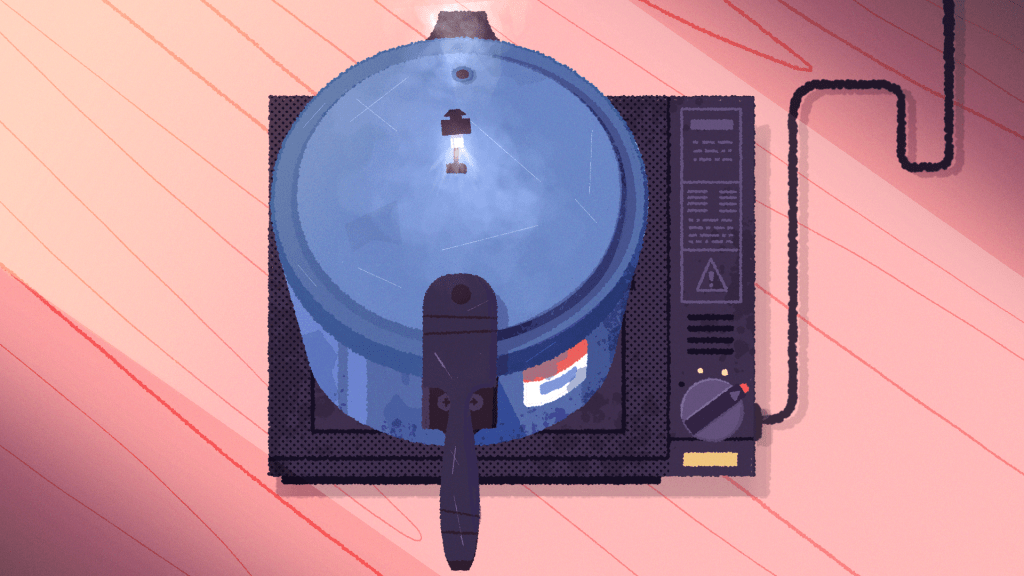
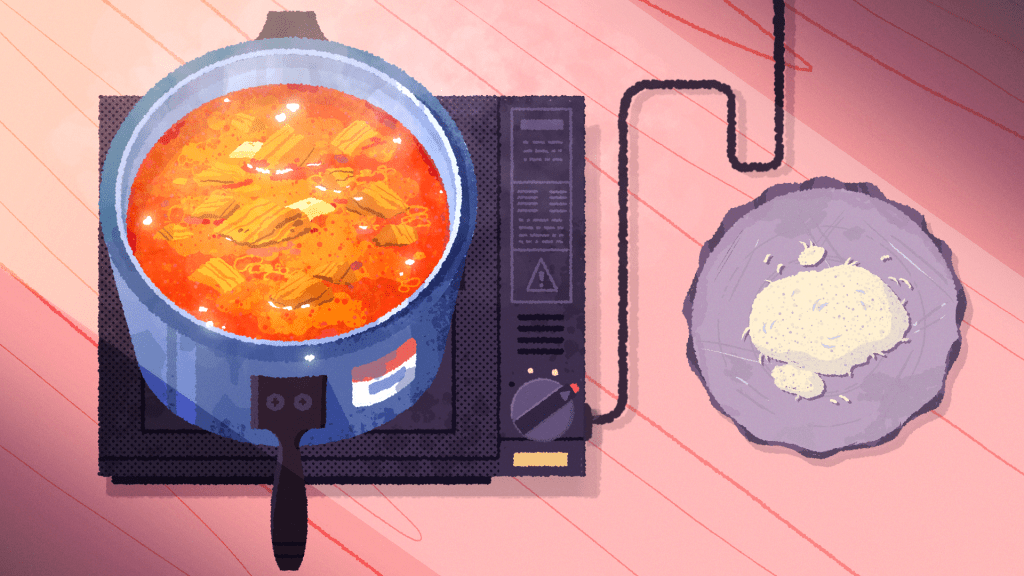
- Click the nozzle of the pressure cooker.
- Click the lid of the pressure cooker to remove it from the pot.
- Add coconut shavings to the pot.
- Add coriander to the pot by clicking the stems that are outlined in white.
Chicken Fry
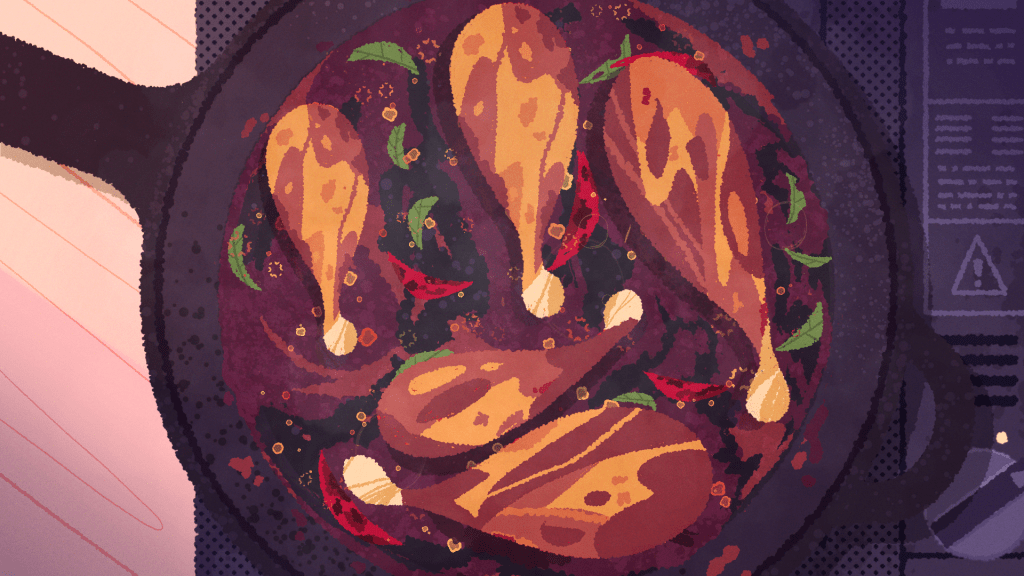
- Click the chicken legs outlined in white to flip them. Do this until all the chicken legs are flipped.
Chapter 6 – Chicken Rasam
Cooking Puzzle 5
Kavin attempts to make a chicken soup for “The Melting Pot.” He struggles to read in Tamil.
Making the tamarind water:

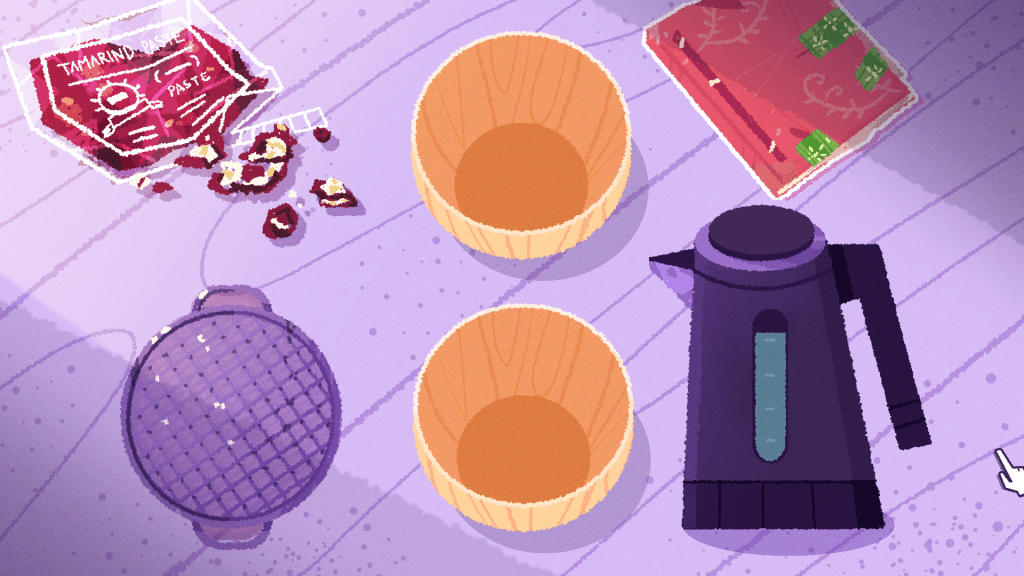
- Add tamarind and water to one of the bowls on the screen. Mix by holding the left-mouse button and dragging in a circular motion.
- Add the sieve to the empty bowl and pour the tamarind water on top of the sieve.
- Add the tamarind back to the other bowl.
- Repeat steps 1-3 until instructed to stop.
Making the chicken rasam gravy:

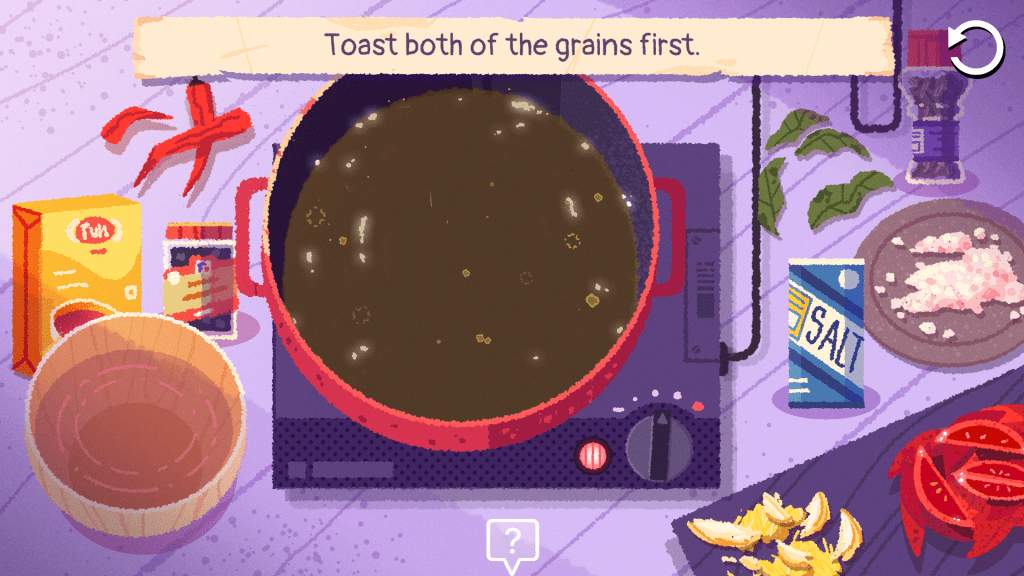
- Add cumin and mustard seeds to the pot.
- Add bay leaves and chilies to the pot.
- Add minced shallots, garlic, and ginger to the pot.
- Add tomatoes and then tamarind water to the pot.
- Add rasam powder and salt to the pot.
Making the chicken stock:
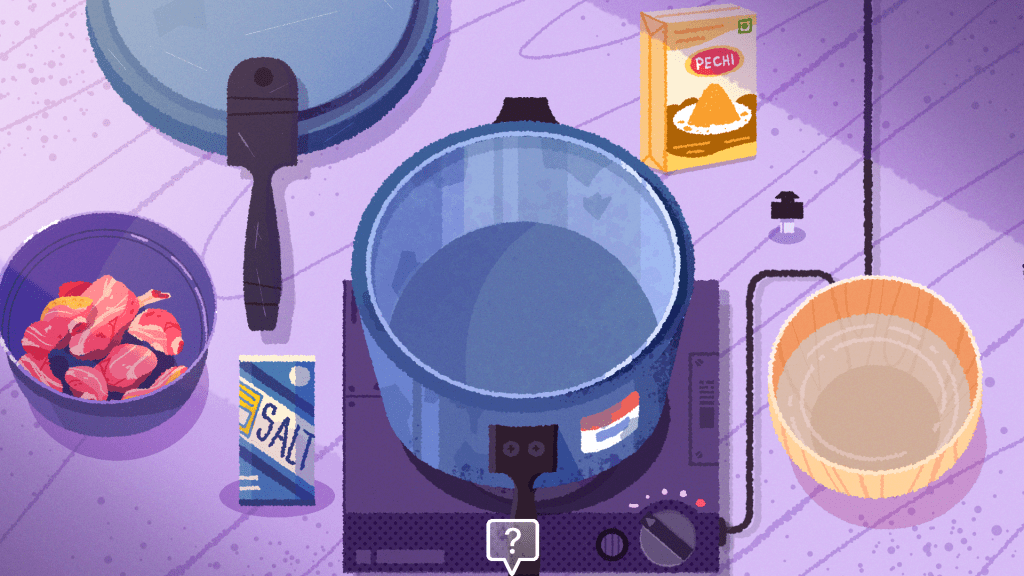
- Add water to the pot.
- Add turmeric, salt, and bone-in chicken to the pot.
- Add the lid and the cooker weight to the lid.
- Turn on the heat.
- Take off the cooker weight and the lid by clicking them.
Assembling the chicken rasam:
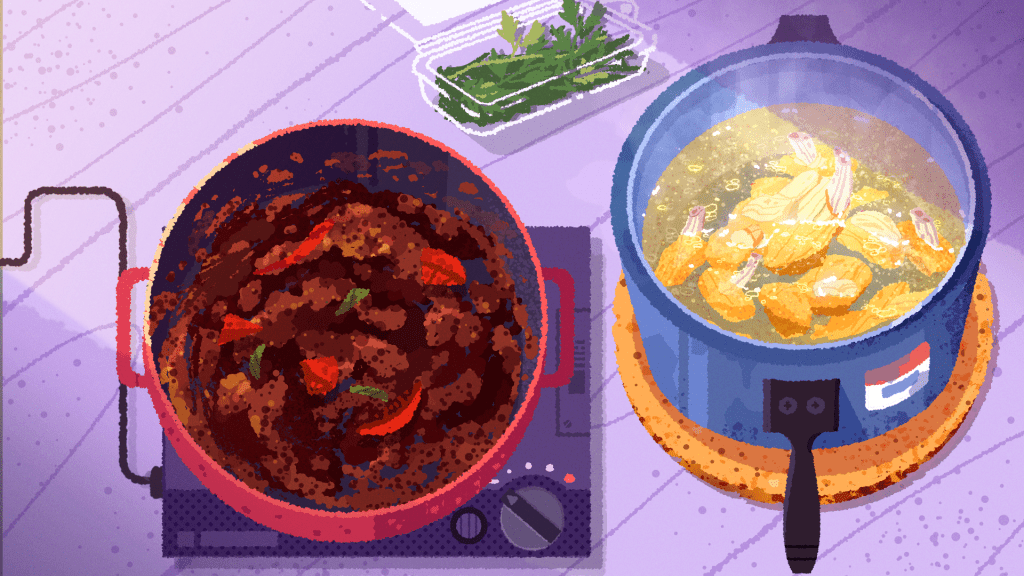
- Click the left-mouse button and drag the chicken stock to the gravy.
- Add the coriander.
Chapter 7 – Dosas Three Ways
Cooking Puzzle 6
Kavin goes to India and learns how to make dosas.
Plain Dosas:

- Pour water on the stone to reduce the heat.
- Set fire to a low setting by clicking the dial on the bottom right of the stovetop.
- Pour the batter and spread it by moving the mouse in a clockwise, circular motion.
- Add oil around the edges and turn up the heat using the same dial.
- Flip using the dosa flipper.
- Flip once more to get the plain dosa on the plate.
Oothappam:
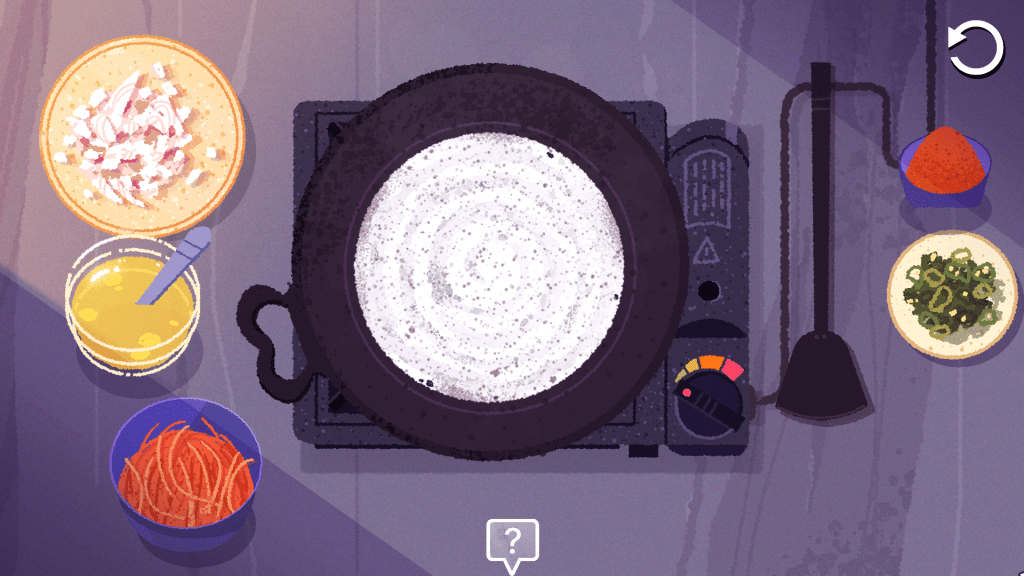
- Follow the same steps as plain dosas, stopping after step 3.
- Add ghee and any of the toppings offered (onion, carrot, green chillies, idli powder).
- Turn the heat up using the same dial and flip using the dosa flipper.
- Flip once more to get the oothappam on the plate.
Kari dosa:
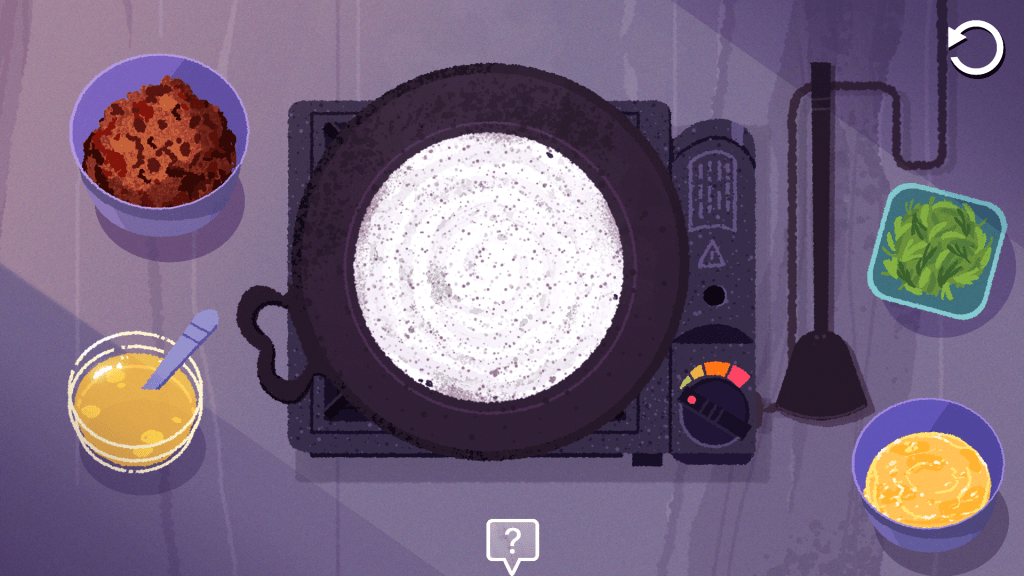
- Follow the steps of plain dosas until after step 3.
- Add ghee, beaten egg, kari, and coriander.
- Turn heat up using the dial and flip using the dosa flipper.
- Flip again using the dosa flipper to transfer the kari dosa on the plate.
E. SOURCES AND RESOURCES
- Wikipedia entry: https://en.wikipedia.org/wiki/Venba_(video_game)
- Metacritic critic reviews:
- (PC): https://www.metacritic.com/game/venba/critic-reviews/?platform=pc\
- (Nintendo Switch): https://www.metacritic.com/game/venba/critic-reviews/?platform=nintendo-switch
- (PS5): https://www.metacritic.com/game/venba/critic-reviews/?platform=playstation-5
- (XBox Series One): https://www.metacritic.com/game/venba/critic-reviews/?platform=xbox-series-x
- YouTube gameplay video (The Gameplay Dudes): https://www.youtube.com/watch?v=yHV8I2Iqx2Y
- Lauren Alfrey. Review of Ready Player Two: Women Gamers and Designed Identity by Shira Chess. Gender and Society, volume 32, issue 3, June 2018. pp. 421-3.
- Shira Chess. Ready Player Two: Women Gamers and Designed Identity. Minnesota UP, 2017.
- Neda Maghbouleh. “‘Inherited nostalgia’ Among Second-Generation Iranian Americans: A Case Study at a Southern California University.” Journal of Intercultural Studies, volume 31, issue 2, April 2010, pp. 199-218.
- Anita Mannur. Culinary Fictions: Food in South Asian Diasporic Culture. Temple UP, 2010.
- Jonathan Ore. “Indie game Venba serves up Tamil cuisine and family’s heartfelt story of life in Canada.” CBC, July 31, 2023.
- R. Radhakrishnan. “Ethnicity in an Age of Diaspora.” Theorizing Diaspora: A Reader, edited by Jana Evans Braziel and Anita Mannur. Blackwell, 2003.
- Retroid_BiPoCket. “Venba Review – This game literally is my life (Spoilers).” r/GamePassClub, Reddit, February 2024.
- Agatha Waszkiewicz. Delicious Pixels: Food in Video Games. De Gruyter Oldenbourg, 2023.
 Stories in Play