Functional Ludostylistics: Establishing an Interdisciplinary Language in Astrid Ensslin’s Literary Gaming

  The hybridity of ludo-literary works are examined in Astrid Ensslin’s monograph Literary Gaming (2014). Ensslin’s text participates along a continuum of works which argue for the coalescence of literature and ludology in scholarship. Namely, she argues that a framework is needed to discuss the broad spectrum of works which blur the boundary between literature and gaming and she proposes to offer such a framework with her “functional ludostylistics,” which will be discussed in further detail later in this essay. The main research questions addressed in her work are: How can stories be approached in a way that reflects gaming structures? Conversely, how do games deploy … Continue reading Functional Ludostylistics: Establishing an Interdisciplinary Language in Astrid Ensslin’s Literary Gaming

SpecLab: Digital Aesthetics and Projects in Speculative Computing

drucker

Drucker, Johanna. SpecLab: Digital Aesthetics and Projects in Speculative Computing. Chicago:   University of Chicago Press, 2009.

Johanna Drucker’s SpecLab is a methodological investigation into the philosophy and application of speculative computing, galvanized within research efforts conducted at the University of Virginia with her colleague, Jerome McGann. Drucker describes speculative computing as an intervention into the relationship between aesthetic representation and subjective knowledge development. It aims to delineate the intellectual “superstructure” or dichotomy between formal, objective logic—or mathesis—often favoured within the practices of digital humanities— and aesthesis—individual thought that challenges authoritarian structures of intelligence (23). As static mechanisms within the organization and dissemination of data, Drucker asserts that digital information systems employed by the humanities—focused upon “functionality” rather than interactivity—problematically indoctrinate the parameters of user engagement through the projection of a cognitive monoculture; a concept which upon greater reflection prompts significant concerns within both scholastic and sociocultural spheres (17). By contrast, the scholar’s vision of speculative computing, and endeavors at SpecLab, boast a phenomenological impulse focused upon the connection between “aesthetic provocation” and human “inflection” (19). In short, Drucker advocates for the necessity of subjectivity within visually oriented learning projects.

Continue reading “SpecLab: Digital Aesthetics and Projects in Speculative Computing”

How to Do Things with Videogames

Bogost, Ian. How to Do Things with Videogames. Minneapolis: Minnesota UP, 2011. Print. With How to Do Things with Videogames, Bogost aims to deconstruct common misconceptions the general public have with videogames as a medium. Bogost is a professor of digital media at the Georgia Institute of Technology, as well as an award-winning videogame designer. Two important credentials considering the aim of this work. His experience as both a theorist and a producer of videogames lends itself well to the issues he raises in the book. Bogost is not only concerned with theoretical problems, he is concerned with theory in … Continue reading How to Do Things with Videogames

The Production of a Feminist InterSpace

This is a position paper in response to Johanna Drucker’s chapter “Interface and Interpretation”, in her 2014 book Graphesis: Visual Forms of Knowledge Productions. To read the author’s related annotated bibliography, click here. The Production of InterSpace: Imagining a Feminist GUI Design Process by Nathalie Down “The structure of an interface is information, not nearly a means to accept it.” I want to draw attention to Drucker’s position that the graphical user interface (GUI) is best understood as a “space of provocation in which a performative event takes place,” rather than a “representation of computational processes” (138). This paradigmatic shift from perceiving interface as a thing … Continue reading The Production of a Feminist InterSpace

Playing Stories and Reading Games

In the introductory chapter of her book Critical Play, Mary Flanagan provides a quote from Greg Costikyan’s “I Have No Words” that touches on the difference between stories and games (Flanagan 7). Stories, according to Costikyan, are linear because the characters do the same things every time you reread them. Games are non-linear because player agency and decision-making possibilities are built into their design. While Flanagan continues to chronicle the intersections of art, games, and play throughout her book, she does not expand on these ideas about the separation of stories and games beyond to call them both “mediums of expression” for artists, and that “noticing the ways language plays with culture, especially language as used by artists, can help designers find methods of consciousness raising, too for social commentary” (118).

Continue reading “Playing Stories and Reading Games”

Injecting Indigeneity in Cyberspace

by Laurence Butet-Roch

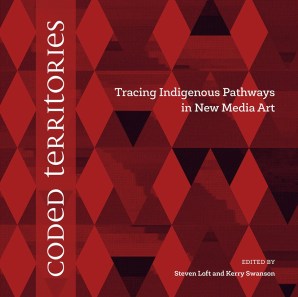
Lewis, J. E. (2014). A Better Dance and Better Prayers: Systems, Structures, and the Future Imaginary in Aboriginal New Media. In S. Loft & K. Swanson (Eds.), Coded Territories: Tracing Indigenous Pathways in New Media Art. Calgary: U of Calgary P, 2009.

coded-territories-1-df136e46

Having founded a network of academics, artists and technologists concerned with figuring out how to infuse Indigenous ways of knowing into virtual environments (AbTec) – computer games, websites, social networks, and the likes – with his partner Skawennati Fragnito in the mid-aughts, Jason Edward Lewis, in his contribution to the recent opus on contemporary Indigenous media practices, first seeks to identify how the Western bias shapes the current digital ecosystem. He observes that the representations of Indigenous characters in online environments perpetuate existing assumptions and stigmas about the past and present of Indigenous communities. So much so that it makes it hard for members of those groups to imagine themselves existing in these new virtual spaces. This is deeply troubling to Lewis, since he claims that failing to envision what the Indigenous presence will look like in hundreds of years could lead to the erasing of these nations. To make his case more potent, he quotes the Pulitzer Prize winning Kiowa author, N. Scott Momaday: “We are what we imagine. Our very existence consists in our imagination of ourselves. Our best destiny is to imagine, at least, completely, who and what, and that we are. The greatest tragedy that can befall us is to go unimagined” (as cited in Lewis, 2009, p.58).

Continue reading “Injecting Indigeneity in Cyberspace”

The Need for Greater Digital Literacy in Technical Communication

Dicks, S. “The effects of digital literacy on the nature of technical communication work.” Digital literacy for technical communication: 21st century theory and practice (2009): 51-82.

———————————————————————–

In this essay, Dicks takes a historical approach to understanding technical writing’s role in the greater context of communication, and analyzes the evolution of technical writing methods as a result of the induction of digital media. The last 15 years have seen seismic social and economic changes motivated by technological innovations. Dicks argues that these changes have dramatically influenced every aspect of technical communication. He argues that as we transition into an era of ubiquitous computing, every aspect of the technical writer’s methodology needs to be revised. By studying the reasons for these changes and the symptoms and  structure of the market as of 2009, Dicks lays out challenges and thinking during the height of the global recession. This reading is one essay in an anthology centered on digital literacy for technical communicators in the 21st century. The anthology focuses on understanding how technology and the current digital writing environment have changed – and continue to change –  the nature of technical communication work.   Continue reading “The Need for Greater Digital Literacy in Technical Communication”

Show Sold Separately: Promos, Spoilers, and Other Media Paratexts.

Gray, Jonathan. Show Sold Separately: Promos, Spoilers, and Other Media Paratexts. New York: New York UP, 2010. Print.

Jonathan Gray’s Show Sold Separately explores how media extensions and paratextual material for television and film—and peripherally literature, music, and videogames—are used to enhance the fan experience and invite viewers to enter into a fictitious world at a deeper level. Gray states that his thesis for his book is premised on the theory that paratexts are both “distinct from” and alike—or, I will argue, intrinsically part of—the text. The book’s thesis is that paratexts are not simply add-ons, spinoffs and also-rans: they create texts, they manage them, and they fill them with many of the meanings that we associate with them” (6). Although most of Gray’s book explores the ways producers create paratextual material to increase profit and build franchises, he also explores the vitality of digitally enabled co-creation between producers (authors, producers, and media hubs) and consumers (fans) for storytelling. Gray’s argument that digital paratexts challenge traditional publishing practices is crucial when attempting to understand the ways that the digital platform has challenged and reconfigured cultures of creation.  Continue reading “Show Sold Separately: Promos, Spoilers, and Other Media Paratexts.”

New Perspectives on Narrative and Multimodality

Post-structuralist devotees of Jacques Derrida tout the famous phrase, “il n’y a pas de hors-texte:” there is no outside-text. Interestingly, the phrase is applicable quite broadly depending on one’s interpretation of the phrase “text” and the scope it may encompass. In the field of digital humanities and regarding themes orbiting around the mandate of Stories in Play, the generative, multimodal element of text is embraced through the ways in which meaning is generated. Such is the case in the collection of academic works edited by Page Ruth and compiled under the title: New Perspectives on Narrative and Multimodality. As the … Continue reading New Perspectives on Narrative and Multimodality

Between Humanities and the Digital: An Intersectional Look at Digital Humanities

  Svenson, Patrik, and David Theo Goldberg, eds. Between Humanities and the Digital.        Cambridge: MIT P, 2015. Print. This compilation of current essays in the digital humanities (DH) sphere deals with the crossover between DH and the traditional humanities disciplines. The volume is a useful resource especially for those academics or interested practitioners who wish to know the status quo of both fields and their interrelations. Many prominent scholars of the DH field have contributed to the volume, including: Alan Liu, Henry Jenkins, Johanna Drucker, Ian Bogost, and N. Katherine Hayles to name a few. This ensures public audiences … Continue reading Between Humanities and the Digital: An Intersectional Look at Digital Humanities